Can you imagine a garden without butterflies? Or a neighborhood, or a world without butterflies? Lately, I've been thinking how sad it would be if my grandchildren (or great-nieces or great-nephews or later generations) couldn't experience the beauty of a simple butterfly.
(Don't worry, this post won't be overly melancholic. There is reason to worry about butterflies' survival in our world, but I'll save that for another post.)
It's not difficult, currently, for me to imagine that kind of world because my garden has gone to sleep for the winter. I won't see butterflies for a few months now. Then again, I have the hope that I'll see many again when the weather warms.
Today, I'm simply thankful for what I've experienced. And hopeful that future generations will be able to experience these graceful insects, too.
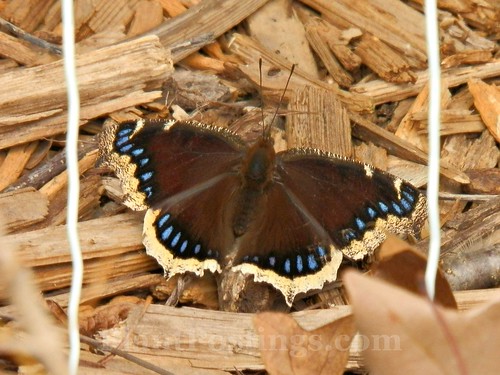
In this part of the world, the past growing season has blessed us with plentiful butterflies of many species. For me, it started in early April, with the first one being a Mourning Cloak (Nymphalis antiopa), shown in the first photo of this post. It gracefully floated by my window on a warm breeze and landed in a sunny spot to bask. Mourning Cloaks are often the first and last butterflies we see here each season.
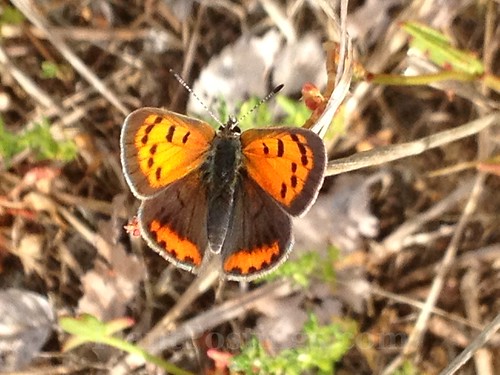
Next came the plentiful American Coppers (Lycaena phlaeas)--too numerous to count--up at our cottage in Marquette County. An open field there is thick with Sheep's Sorrel (Rumex acetosella), which likely explains their abundance as it's a larval host plant for the species.
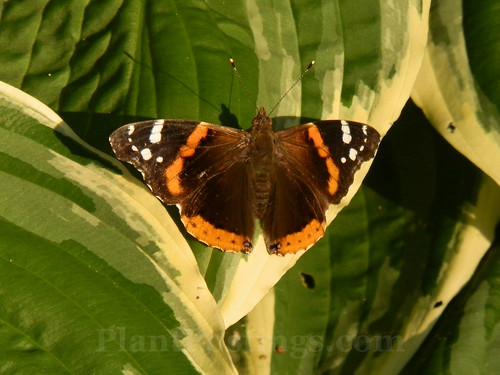
Then, one late afternoon in early summer, as I was gazing outside, I noticed several bright, orange-red butterflies darting and swooping and then returning to the same spot. When I went outside to investigate, I discovered they were Red Admirals (Vanessa atalanta). Apparently, this flight pattern is common for this species.
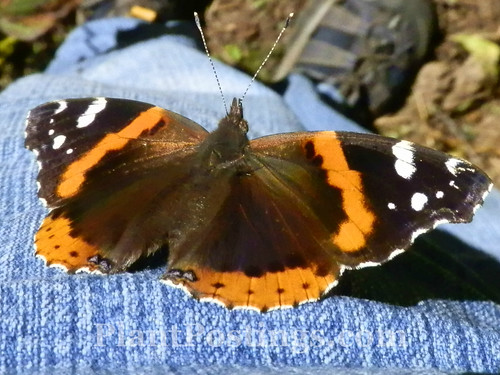
It seemed to be a good year for Red Admirals. I saw them in numerous spots throughout the state and throughout the season. This one even landed on my pant leg as I was photographing plants.
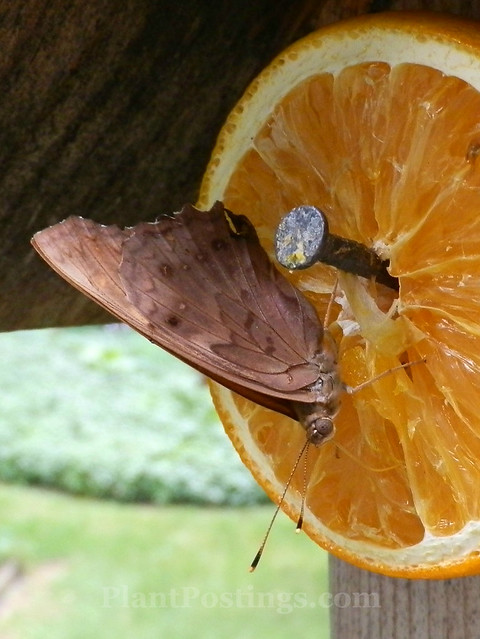
Just as I was about to stop posting oranges for the Orioles, this little fellow showed up. I learned it was a Tawny Emperor (Asterocampa clyton), which often feeds on rotting fruit.

This Tawny Emperor (or a friend) made repeated visits, and for a few days in a row it rested on and consumed the oranges for several hours straight.
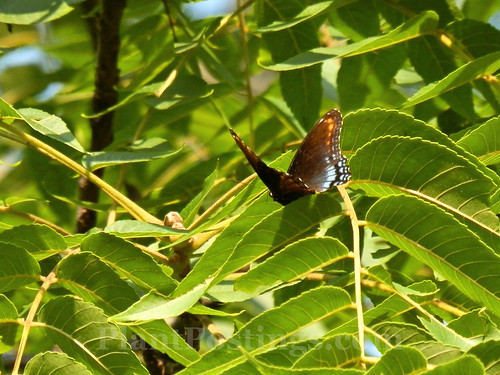
Near the same spot at our cottage where I saw the American Coppers and the Red Admirals, this Red-Spotted Purple (Limenitis arthemis astyanax) paid a visit. At one point, it landed on the fishman's hand, and then basked in the sun in the upper branches of this Ash tree.

On various hikes throughout the summer, we saw Viceroys (Limenitis archippus), which mimic Monarchs; and

Pearl Crescents (Phyciodes tharos), a very common butterfly in the Eastern U.S.
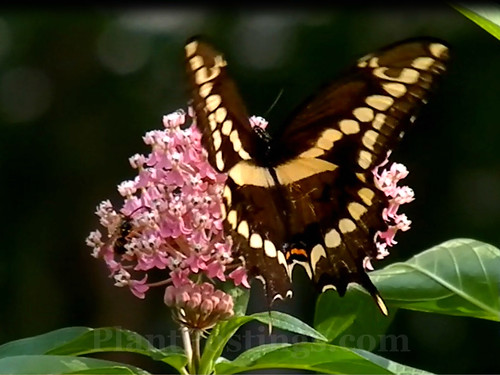
And then there were the surprises, like this Giant Swallowtail (Papilio cresphontes), which is less common in my state. I don't ever recall seeing one before. It was huge--I'd estimate a wingspan of five to six inches! It was difficult to photograph, because its wings flapped so fast. (The above photo is a stop-action clip from a video.)
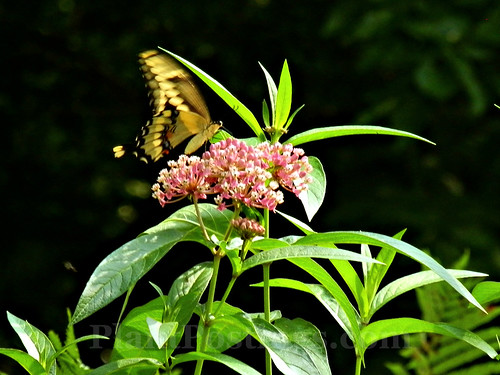
In this photo, you can see the beautiful, bright underside of its wings. I learned that, along with Monarchs, the Giant Swallowtail is attracted to Swamp Milkweed (Asclepias incarnata), and that its larval host plants include members of the Citrus family.
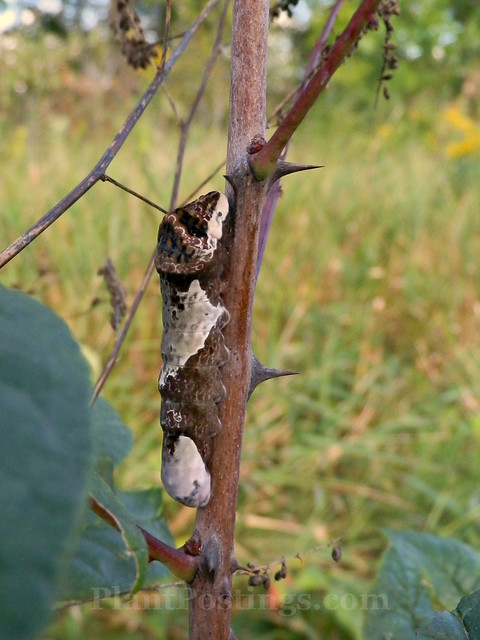
Another host plant is Prickly Ash (Zanthoxylum americanum), which is more common in my northern locale than Citrus. I nearly missed this Giant Swallowtail (and its friend below) when I walked by it during a hike one day. It's hard to believe a squishy caterpillar can survive those sharp thorns, but I guess it knows what it's doing.
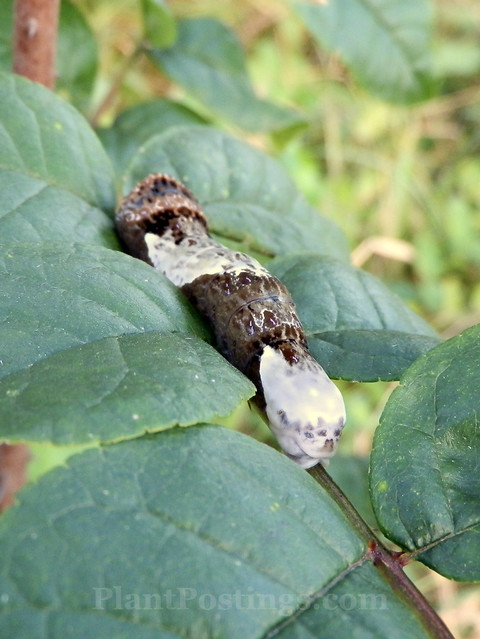
Its camouflage makes it look like bird droppings. Fascinating.
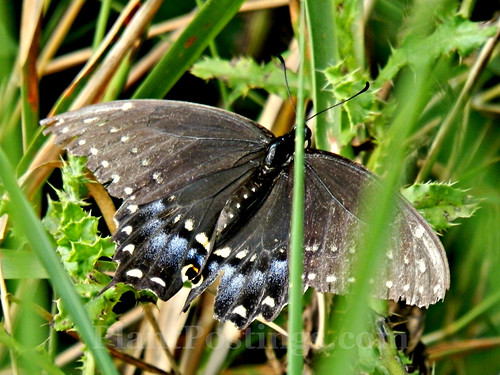
I also had the pleasure of seeing many Black Swallowtails (Papilio polyxenes) and Eastern Tiger Swallowtails (Papilio glaucus). (I didn't get any decent photos of the latter this year and I didn't want to cheat by using an old photo from last year. Tiger Swallowtails didn't seem quite as numerous this year as last--at least not in my garden and surroundings.)
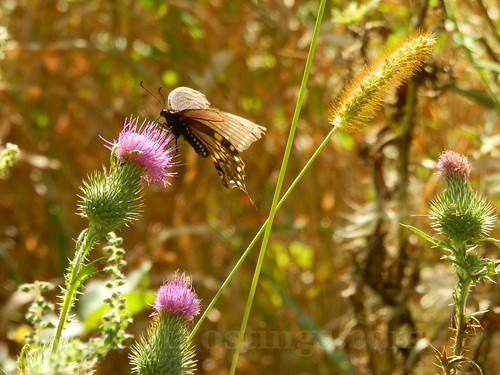
There was something mystical about this scene. This battered butterfly was somewhat difficult to identify and was probably at the end of its life. But it had just enough markings on its wings and body to identify it as another Black Swallowtail.
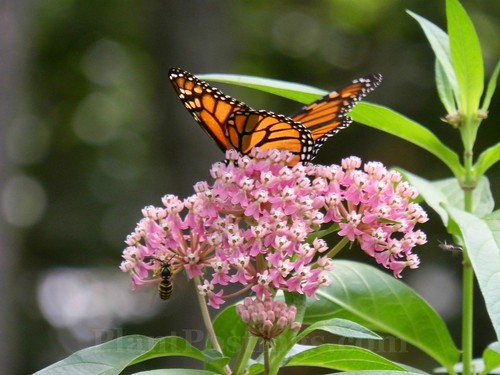
Believe it or not, the most plentiful butterfly in my garden this year was the Monarch (Danaus plexippus). By now, I suppose, just about everyone is aware that their numbers (at least the migrating Monarchs in the central and Eastern U.S.) were at a record low in North America in 2013.
But starting in mid-June this year, their numbers began exploding in this part of the state. And once the Swamp Milkweed began to bloom in my garden, I saw at least one (and sometimes many more) each day. I felt truly blessed.
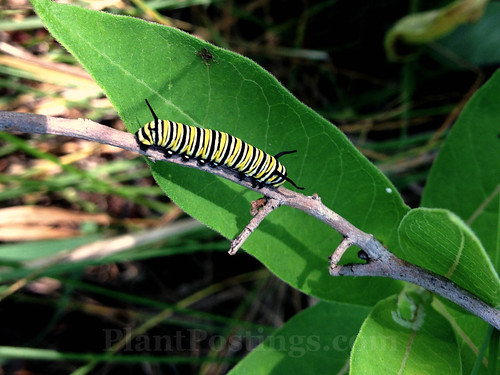
During a trip to the cottage, I found this Monarch caterpillar. The property is thick with Milkweed plants of various species. I believe this is Common Milkweed (Asclepias syriaca). Later in the summer, when I transplanted some A. syriaca to my home garden, I found a tiny instar cat, which I supplied with fresh Milkweed in a very sheltered area of the garden. I didn't bring it inside to raise it (which I regret), but it was a very healthy fifth instar before it crawled away to form a chrysalis.
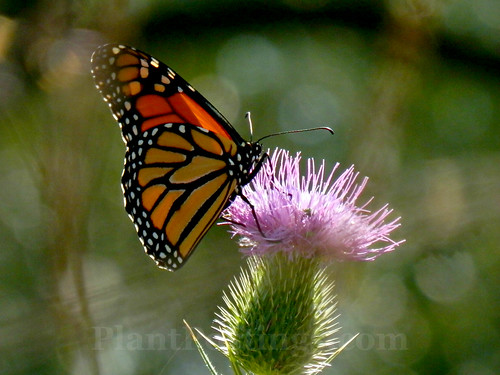
We also saw many Monarchs during our hikes, like this healthy one enjoying nectar from a Thistle.
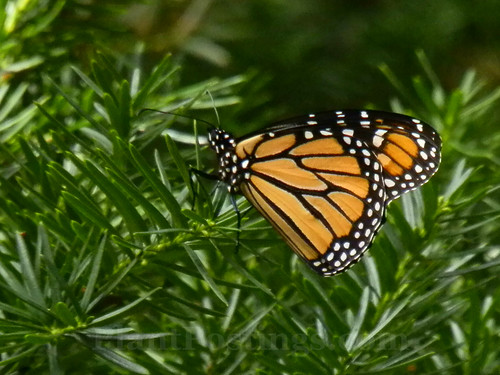
I never did find the chrysalis from that Monarch cat in my garden, but about 10-12 days later, two fresh and healthy, nearly perfect Monarchs were mating and then resting on the Yew shrubs. One seemed to linger a bit before it floated away on a breeze. Silly me for thinking it was the one I'd fed and nurtured.
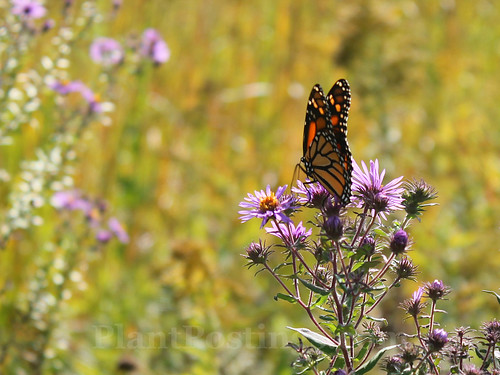
There were still many more Monarchs to see--nearly every time I hiked.
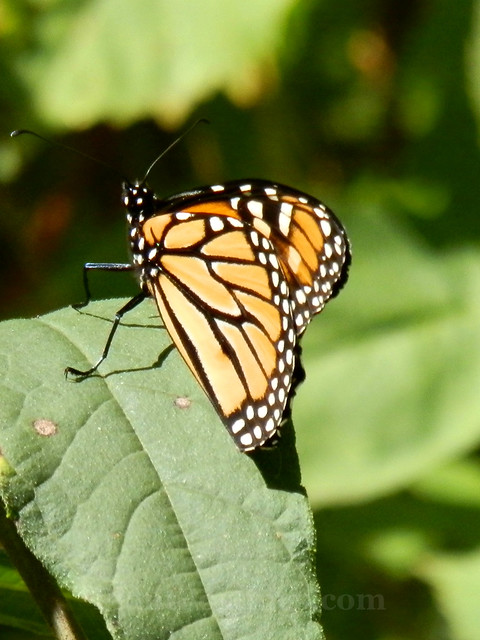
One autumn day at the cottage, we saw numerous Monarchs migrating gracefully along the lakeshore, resting briefly on leaves and on flowering plants in the bright sunlight.
I thought, perhaps, those would be among the last Monarchs I would see. But they kept coming.
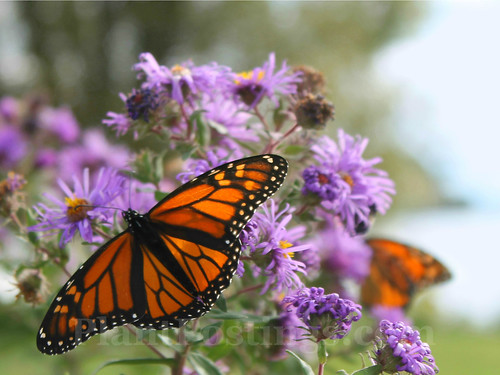
The last butterflies I saw this season were these Monarchs and their 10 or so friends. We'd already had a light frost, and I didn't expect to see anymore. But a fortuitous trip to the northeast corner of Lake Mendota to photograph fall foliage revealed this gift. It was an unexpected moment of grace.
I thought it would be fun to try out Google's Auto Awesome feature with some of my butterfly photos and videos. All you have to do is create a folder in Google Photos and add your photos and videos. The Google people automatically add music and transitions, and then notify you when your Auto Awesome video is ready. I should have labeled the photos so perhaps they would have added text, too. But as simple as it is, the resulting video is light and rather hopeful. I like the way it ends with the fifth instar Monarch caterpillar.
What a beautiful world it is when the butterflies (and caterpillars) are with us!
Thanks to wisconsinbutterflies.org and Butterflies and Moths of North America, for help identifying these and other species of butterflies.
(I'm taking a short break. My next planned post will be at the end of the month for the "Garden Lessons Learned" meme. To all those who celebrate Thanksgiving, I do hope you'll have a safe, healthy, and happy holiday. And thanks, to everyone who reads this, for your friendship!)