Showing posts with label native plants. Show all posts

September 26, 2026

Native Plants That Shine Through Autumn

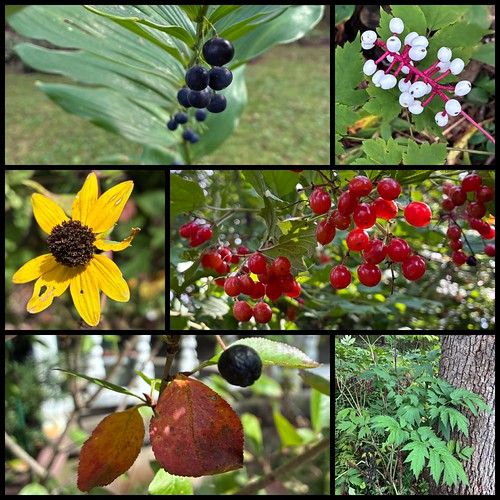
Autumn collage

Over the years, I've been slowly adding more native plants to the garden, and encouraging volunteers. In fact, going forward I'm avoiding planting non-native perennials--with a few exceptions. It's not a full-scale redesign, but rather a slow adjustment. (Annuals that die in our cold winters are another story.)

At this point in the season, most of my native plants have finished blooming, and the ones that still bloom have seen much better days. (Perfectly normal, of course: It's part of the natural seasonal progression, and soon most will go dormant after the first frost.)

With that said, many native plants here are still attractive garden highlights--with colorful foliage, berries, and garden structure. They're holding their shape and adding beauty and seasonal wildlife value to the garden. In one way or another, all native plants benefit the local ecosystem, and some remain attractive, active highlights right through autumn and into the winter. While books could be written (and have been) about the ecosystem benefits of each native plant, I'm focusing here mainly on the garden aesthetics. Here are a few examples:

Polygonatum biflorum

Solomon's Seal (Polygonatum biflorum): These attractive blue berries persist for months, and the arching stems resemble feathers in the wind.

Actaea pachypoda

White Baneberry (Actaea pachypoda): Bold, Maple-shaped leaves frame "doll's eyes" berries that branch out from bright red stalks.

Viburnum trilobum

Highbush Cranberry (Viburnum trilobum): This shrub holds its beauty through four seasons. The foliage shifts to multicolored shades of bronze to bright red in autumn, and the berries often persist into the winter.
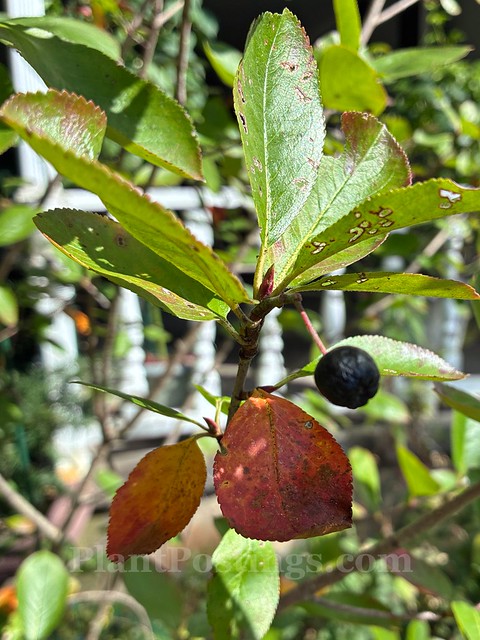
Aronia melanocarpa

Chokeberry (Aronia melanocarpa): An excellent substitute for invasive Barberries (Berberis spp.), this shrub is still settling in here in my garden. It had a tough year with strange weather, but the edible, dark berries and the colorful foliage are worth the patience and effort. I will cut it way back in the spring to encourage more growth.

Actaea racemosa

Black Cohosh (Actaea racemosa): This plant is the star of the garden in midsummer, with its tall, spiky, fluffy white flowers that tower over the understory plants. I've clipped the seeds in this particular grouping and placed them in the woods to encourage new plants. Even when clipped, they provide an attractive, shrub-like form next to the Oak trees.

Heliopsis helianthoides

False Sunflower (Heliopsis helianthoides): These plants bloom from mid-June through early October. What can I say? The pollinators enjoy the nectar, the birds eat the seeds, and the blooms offer garden beauty until the first frost.

These native plants and so many more make autumn a special time in our little corner of the world.

I'm linking in with "Six on Saturday" at Garden Ruminations. Thanks to Jim for hosting!

July 29, 2026

A Perfect Day in an Imperfect World

IMG_8775

IMG_8769

IMG_8783

IMG_8764

red admiral

IMG_8792

IMG_8758

IMG_8772

IMG_8752

eight-spotted forester

IMG_8748

IMG_8745

IMG_8782

IMG_8749

monarch

IMG_8761

IMG_8777

IMG_8756

IMG_8757

IMG_8767

IMG_8746

IMG_8750

IMG_8781

Partly cloudy, light breeze, 78F
Pollinators aplenty
Peak summer display
Swaths of blooming native plants

THE OVERVIEW
"Summer Guitar," by Amaksi

December 14, 2025

Miscellaneous Pleasant Memories of 2025

bumble on white wild indigo

Do you designate a folder or a notebook (online or physical) to save pleasant experiences you don't want to forget?

As a blogger, I often set aside photos that capture "magical" moments I'd like to remember. They're hard to put into words or fit into a blog post. I'm sharing a few here that remind me of special days and unique experiences during the past year.

I've placed them roughly in the order they occurred. The first six, including the top photo of the bumble bee exploring White Wild Indigo (Baptisia alba), greeted me on one of those partly cloudy, perfect days in mid-June. The final three are early October memories, when the garden, nature, and local harvests were full, colorful, and plentiful.

There are many more memories, of course, but these were specifically placed in my "Miscellaneous 2025" folder.

golden alexander

A stem of Golden Alexander (Zizia aurea), about to pop and declare the joy of summer.

blue flag iris

Blue Flag Iris, at peace within its marshy home. I believe this is Southern Blue Flag (I. virginica), because it displays more yellow on its sepals than Northern Blue Flag (I. versicolor). Both are native here.

redwing in prairie

A redwing blackbird nestled among the grasses and forbs of its favorite prairie.

false sunflower

Oxeye Sunflower (Heliopsis helianthoides), ready to burst in the warm sunlight.

foxglove beardtongue

The solid, yet graceful and fascinating structure of Foxglove Beardtongue (Penstemon digitalis).

bird's foot trefoil

Bird's Foot Trefoil (Lotus corniculatus), declaring the growing season extending a bit longer into autumn. Introduced here, this plant can be invasive in some settings. But it certainly is bright and cheery on a warm autumn day.

apples

Locally grown apples (Malus varieties), crowned by a delicious apple cider donut.

zinnia

And finally, a bright Zinnia bloom (Z. elegans 'State Fair Mix'), started from seed in the sunroom in late March and sparkling through October.

Do you have special memories of gardens and nature from the past year? Please share them!

September 11, 2025

Pushing Ranges With Nearly Native Plants

nearly native collage

Do you have a rough (or maybe quite organized) plan for your garden? From the start of our time at this property, I've aimed for an informal three-section plan for this garden:
  • Near/around the house: annuals, perennials, potted plants, and vegetables;
  • Middle section: cultivated perennials, both native and non-native; and
  • Back woodland: native trees and plants.

Most of the perennials in the middle and back sections were here when we moved in. Over time, I've tried to incorporate more native plants in all three sections. And while it's nowhere near a devoted native plant garden, it has moved in that direction. In recent years, I've rarely added non-native perennials, with the exception of Alliums (because the rabbits won't eat them) and a few other plants that don't spread much, including Hellebores, a few foundation plants, and some potted plants.

In addition, I've added a few favorites that are nearly native to my area, including:

woodland pinkroot

Woodland Pinkroot (Spigelia marilandica), which is native starting just south of here, from Illinois south to Texas and Florida. It's hardy in USDA zones 5-9. A colorful shade plant (which is rare), it offers midsummer dramatic blooms, and it forms a pleasant ground cover. I cage these plants in a few locations, because the rabbits sometimes eat them.

climbing prairie rose

Climbing Prairie Rose (Rosa setigera) has a similar range. While it's native in the state, its original range started just south of my area, extending further east and northeast, as well as south. It's hardy in USDA zones 5-8. This one is an old-fashioned beauty that climbs up and down the arbor. Though the scent is subtle, it's pleasant, and the blooms last for several weeks in midsummer.

maypop

Purple Passionflower (Passiflora incarnata) also is native from Illinois south through Florida, and areas east and slightly west. It's hardy in USDA zones 5-9. I could study its incredibly unique blooms for hours. I didn't even realize I could overwinter it here until a few years ago. I keep one potted in the sunroom all winter and outdoors on the front porch in the summer. The other plants--which are outdoors all winter--go dormant, then in spring and summer they spread out along a trellis on the western, sunny side of the house.

purple coneflower

Purple Coneflower (Echinacea purpurea), which I've had in my garden from the beginning, is native in most states surrounding Wisconsin, but not technically native here. Other species of Echinacea are more commonly native in Wisconsin. This one is hardy in USDA zones 3-8. It's definitely a standard garden beauty, a great cut flower, and a favorite of the pollinators.

blue mistflower

Finally, Blue Mistflower (Conoclinium coelestinum) is native to states nearly surrounding Wisconsin, and even up into some Canadian provinces north of us. It's hardy in USDA zones 5-10. I have a complicated relationship with this plant. It's a unique, beautiful shade of lilac/pink, and it blooms in late summer/early fall. The blooms are gorgeous and they're wonderful cut flowers. What's interesting is that the rabbits eat Blue Mistflower when it's not protected, but where they can't reach it in a protected area it tends to take over the garden. Apparently, there's no halfway with this plant, in my garden anyway. (But I still love it.)

I'm so pleased that these beauties grace my garden. They're lovely, most are great cut flowers, and they feed the pollinators. And I'm so happy that they have a place here.

*Note: All native ranges are sourced from the Biota of North America Program (BONAP); all hardiness zones are from the Missouri Botanical Garden; they may vary with other sources.

July 09, 2025

Sunday Highlights at the Memphis Fling

Beasley 4

My last day at the Memphis Fling was bright, colorful, and wonderful like the others. (I regrettably didn't stay for the alternate activities on Monday.) Again, I'll keep the words to a minimum, and you can read more on the Fling website and in our social media posts.

Our first stop was at the home of Pam Beasley in the suburb of Germantown. Her garden was welcoming, and full of creative touches throughout (photos above and below):

Beasley 5

Beasley 1

Beasley 3

Beasley 2

Great curb appeal, lush walkways, creative arbors covered with flowers and baskets, and comfy seating areas adorned the gardens.

Next, we headed to the eclectic, 50-acre property of Susan and Jon Thompson: 

Thompson 2

Thompson 4

Thompson 1

Beautiful waterways and water features, and colorful planting combinations graced the property.

Thompson 3

Thompson 5

Artfully arranged rock and brick displays and espalied trees created more magic.

Tatyana and Alex Jankov's property was equally welcoming in their own unique style:

Jankov 1

Spans of native plants and pollinator favorites greeted us at the front.

Jankov 2

Jankov 5

Jankov 3

Raised planting beds and a creative and tidy work area caught my eye, as did a water station for wild garden friends. It reminded me to add marbles to my own water bowl at home.

Jankov 4

The Jankovs also had an impressive collection of beautiful Dahlias at peak bloom.

Next, Tammy and Jim Hausman's home and gardens:

Hausman 1

Hausman 2

Hausman 3

The pool was a fun element, along with comfy seating and artful planters and birdhouses.

And the special event...floral arranging by John Mark Sharpe:

Hausman 4

It was a nifty treat to see him work through the stages of a grand floral display.

Hausman 5

One...

Hausman 6

Two...

Hausman 7

Three! (Admittedly, I think I liked it equally at the earliest stages all the way through to the end.)

For lunch, we visited Bobby Lanier Farm Park:

Lanier Millstone 5

Lanier Millstone 1

A working model of a community-based suburban farm, it featured plentiful lush crops and a meeting area for our luncheon.

Lanier Millstone 2

Lanier Millstone 3

Artful wreaths and floral arrangements adorned the windows and the tables.

At Millstone Market and Nursery:

Lanier MIllstone 4

I didn't take many photos, but I loved this moss "purse." I think I will make one very soon...

Three more gardens greeted us on Sunday, in the East Memphis/Midtown area. For some reason, at the Andy Williams and John Morris garden, I focused mainly on the plants, including:

Williams Morris 1

Williams Morris 2

Williams Morris 3

White, blue, and pink Hydrangeas of various species and cultivars.

Williams Morris 4

And blooms of mixed colors.

Williams Morris 5

I was also fascinated by the stages of Magnolia (M. grandiflora) development, from bud to bloom to seedhead.

The gardens of Amy Bateson and Sarah Tinkler were contemplative:

Bateson Tinkler 1

Bateson Tinkler 2

Bateson Tinkler 3

Bateson Tinkler 5

Statuaries, floral displays, and water features were calm and relaxing.

Bateson Tinkler 4

This bike-hauling vehicle also captured my imagination.

Our final destination on Sunday was the quaint, sweet property of Bernhard Meck and Dakoda Davis:

Meck Davis 1

Meck Davis 2

Meck Davis 3

A lovely home, colorful garden decorations, and special lyrics greeted us...but then there was a surprise...

Meck Davis 4

A dwarf caiman in an indoor enclosure! To read more about it, check out Bernhard Meck's description.

Meck Davis 5

I'll leave you with a photo of a budding and blooming Rose from the Meck/Davis garden, because so many Roses were at peak bloom and beauty during the Memphis Fling. It was a magical time and a wonderful event!

Visit the Fling website and our social media posts for more coverage. And plan now for next year's Fling in Buffalo, N.Y., July 9-12, 2026.