Showing posts with label Virginia Bluebells. Show all posts

May 15, 2023

Woodland Wildflowers for May Bloom Day

Violas

For this bloom day, I'm focusing on a few ephemerals and wildflowers in our woodland at the back of our garden. Many other plants are blooming, but they'll have their day. In addition to the plentiful Violets (Viola spp., above) flourishing around the property, many other wildflowers are lovely this month.

Mertensia virginica

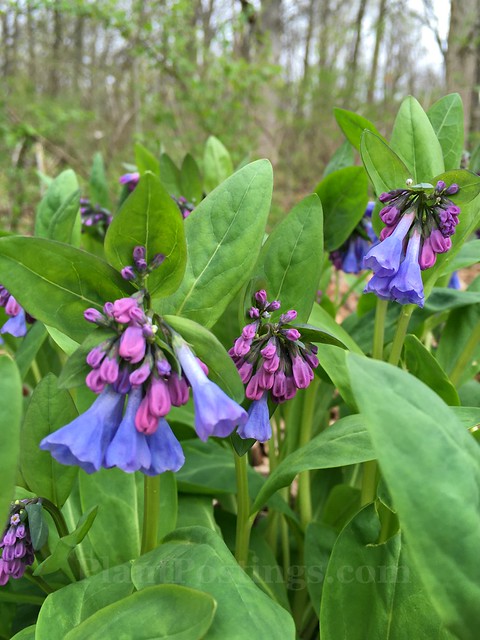
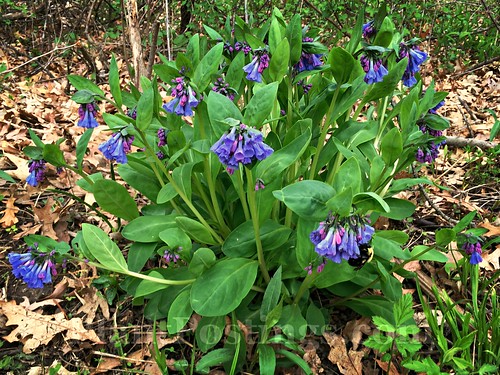
The Virginia Bluebells (Mertensia virginica) are fading, but I captured a few pics before they were done.

Claytonia virginica

Spring Beauties (Claytonia virginica) have been blooming since early April! They're such a great native plant option to support pollinators at the beginning of the season.

Asarum canadense

While the Wild Ginger (Asarum canadense) flaunts its heart-shaped foliage, its fascinating, fuzzy flowers hide underneath and support flies, beetles, ants, and some butterflies.

Arisaema triphyllum

Each year, I'm thrilled to welcome back the plentiful Jack-in-the-Pulpits (Arisaema triphyllum). They have such a unique form and are so at home in the back woods.

Trillium recurvatum

The Trilliums are in full bloom and seem very happy this spring. Prairie Trillium (T. recurvatum) hides under Oak leaf litter and ground cover, and always surprises me when it pops up in May.

Trillium grandiflorum

Each year since the drought in 2012, the Great White Trilliums (T. grandiflorum) have expanded around the property. They are so regal.

Trillium erectum

And, finally, the Red Trillium (T. erectum) graces its own special spot along the woodland edge.

It's a beautiful day and month in the garden! To enjoy other lovelies on this Garden Bloggers Bloom Day, visit May Dreams Gardens. 

April 22, 2023

Six Ephemerals on Saturday

spring beauties buds

It's a crazy spring here in Southern Wisconsin! While April is always a variable month, it's been terribly dramatic this year. We had a week of summer-like weather (70s/80s F) the second week of the month, followed by wintry/early spring temps since. All the plants got going during the warm stretch, only to be covered in snow and cold weather the following week.

As we approach May, the forecast looks a little better. (Fingers crossed.) I'm joining in with Garden Ruminations' Six on Saturday meme: highlighting six things of note in the garden. The items I'm sharing are spring ephemeral plants that bloom for a short time in spring, and then fade.

Most shared here are long-time friends, planted by Mother Nature, that have appeared on our property every spring since we moved in two decades ago.

virginia bluebells

1. The exception is the Virginia Bluebells (Mertensia virginica). I planted these because I like them. The conditions are right and they are native plants. The only challenge is that rabbits like to eat them. So...because the rabbits have few predators here, mine must be caged. The plants are starting to spread beyond the cages, so I've added native Alliums around them to help keep the rabbits at bay.

wild ginger

2. Wild Ginger (Asarum canadense) is thriving in and at the edge of the woods. The fuzzy foliage and tiny, bell-shaped red blooms at the base are enchanting.

virginia waterleaf

3. Virginia Waterleaf (Hydrophyllum virginianum) is a happy groundcover that blooms a little later in the spring. I'm cheating just a bit with this one; it's not a true ephemeral, but the flowers bloom and fade quickly in May.

spring beauties

4. This has been the year for Spring Beauties (Claytonia virginica). They've been blooming for a couple of weeks now: closing up during nighttime and cooler weather (see top photo), and re-bursting with pink pollen given warmth and sunshine.

red trillium

5. The Trilliums have emerged, which usually marks the end of nighttime freezing temps. While the Great White Trilliums (T. grandiflorum) have barely emerged, the Red Trilliums (T. erectum) (shown here) are just about to bloom.

mayapple

6. Finally, the large patch of Mayapples (Podophyllum peltatum) is about to dominate its hillside at the back of our woodland. It's quite a dramatic transformation to see the "umbrella" foliage fully open.

Spring is here, even if it's taking two steps forward and one step back.

May 05, 2020

Bluebells, Bumble Bees, and Bunnies

bluebells 2

Last week, during a hike at a favorite local state park, I noticed a beautiful patch of Virginia Bluebells (Mertensia virginica). This plant is native to most of Eastern North America and is beloved by many ... gardeners and nature-lovers, alike. This little patch I discovered was noteworthy, both because of its beauty and because it was the only patch I saw that day after hiking in a large area.

bluebells 1

Based on my own experience with Virginia Bluebells, I immediately formed a hypothesis. This patch was near the parking lot. Could it be that Mertensia has trouble establishing elsewhere in the park because of rabbits? Perhaps the rabbits tend to shy away from the busy parking lot area.

bluebells destroyed

My theory was based on many years of trying to get Virginia Bluebells established in my own garden. I do have several patches still growing at home--plants I started from seed several years ago. But the one year they did bloom, the rabbits chewed them to bits just as they were blooming. This year, I don't see any buds, for some reason, although I've caged the plants from the bunnies.

bluebells 3

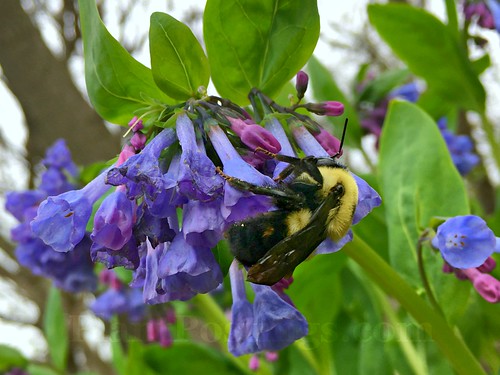
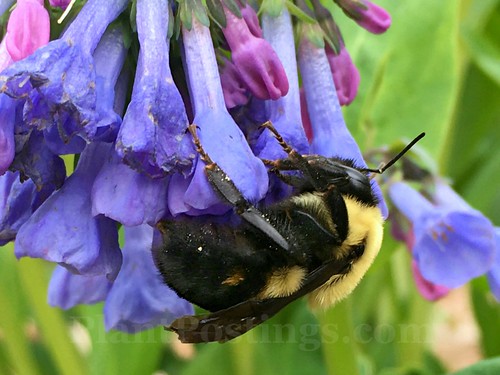
In any case, if you DON'T have a rabbit problem or you have a protected area in your garden, Mertensia virginica is an excellent plant to support native bumble bees. The plant blooms just as the queens are getting active in the spring and looking for early pollen and nectar sources. On this beautiful patch at the state park, I observed a resting queen.

bumble 1

I've noticed many lethargic queens lately, during walks around the block and resting in unusual locations.

bumble 2

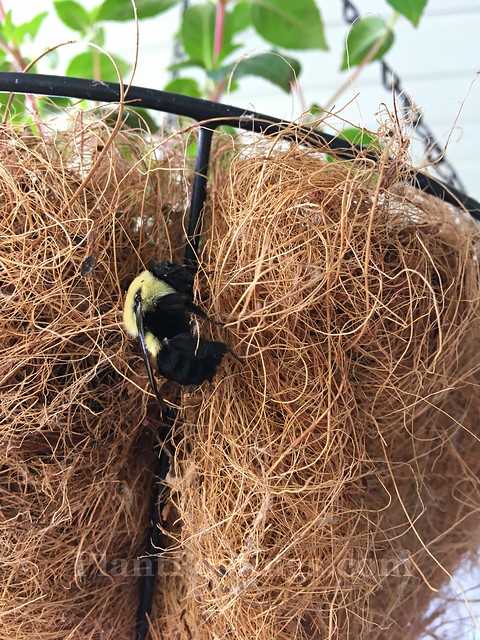
Like this one in a dangerous spot on the front porch. I don't usually interfere with nature, but I very carefully lifted her with a piece of light cardboard and placed her near some blooming flowers. I'm a little worried about the bumble bee queens this spring, because of how cool our weather has been lately, with at least one frost/freeze in the forecast this week. Blooming plants are still rather scarce.

bluebells 4

The Xerces Society for Invertebrate Conservation recently published this excellent article on Five Ways to Support Queen Bumble Bees. Native plants like Virginia Bluebells definitely play an important role--one of many reasons these beautiful blooms are worth protecting from hungry bunnies.

April 25, 2018

Patience Pays! (and Persistence Revisited)

plot 2016

Back in 2012, we had a major drought here in the Madison area and much of Southern Wisconsin. I realize folks in the Southwest have them frequently, but a drought of this magnitude is rare for us. Our plants, animals, and people really struggle when it happens.

It didn't rain, at all, from mid-June through mid-August, and not much before and after that. We didn't officially come out of the drought until April 2013.

I mention all of this, because the drought set back several areas of the garden, including one near a large Oak tree (shown above) that was brown and dead, even by the next summer.

So, I did a little inexpensive experiment. I try to introduce only native plants back in the woods, to keep the area as close to "natural" as possible. I seeded the area with Pennsylvania Sedge (Carex pensylvanica) and Virginia Bluebells (Mertensia virginica). Both are native, rabbit-resistant, woodland plants, and they tolerate some summer drought. Plus, I like them.

Much to my surprise, by the next summer, the area was filled with Virginia Creeper (Parthenocissus quinquefolia), Virginia Waterleaf (Hydrophyllum virginianum), Ostrich Ferns (Matteuccia struthiopteris), and even Great White Trilliums (T. grandiflorum) and other native plants that hadn't been there before!

bluebells 2016

Meanwhile, the Pennsylvania Sedge was spotty, and the Virginia Bluebells looked like this, with no blooms, for several years.

bluebells 1

Until now! Do you see it?

bluebells 2

How about now?

bluebells 3

Yes! Buds!

bluebells 4

Several of the Virginia Bluebells will bloom very soon! Cheers!

bluebells

Maybe someday in the not-too-distant future, I'll have a healthy patch of them back there, like this grouping I saw during a hike.

survivors collage

Oh, by the way, the plants that were snowed in at my last post survived, and are now thriving with our near-perfect springtime weather. Boy, they're tough!

I'm linking this post--because of the native, about-to-bloom Virginia Bluebells--to Gail's Wildflower Wednesday meme, over at Clay and Limestone. Check it out!

January 24, 2018

Plant of the Month: Virginia Bluebells

bluebells 1

It's Wildflower Wednesday, and of course there are no wildflowers blooming in my USDA zone 5a garden in January. In fact, this plant has never bloomed in my garden.

bluebells 3

I planted Virginia Bluebells (Mertensia virginica) from seed in the fall of 2013. Every year, I find more plants along the edge of our little woodland, but after five years, they haven't bloomed. Perhaps the rabbits are eating the tiny buds before they have a chance to flower, though I've read it's a rabbit-resistant plant.

bluebells 2

I won't give up, because I'm hoping eventually they'll colonize among the Trilliums, Bloodroot, Spring Beauties, and the other spring ephemerals. Virginia Bluebells are native here, and I've seen them many times in nearby forests, parks, and nature centers.

Virginia Bluebells are native to much of eastern North America--from Maine and Georgia westward through Minnesota and Kansas, according to the Lady Bird Johnson Wildflower Center.

The plants emerge in early spring, and often have a slight reddish tinge to the foliage until they grow larger. Maximum height is about two feet. In the wild, they grow in moist woods and clearings and along river edges. They prefer part shade or full shade and rich soil. Buds begin pink and open to an exquisite blue, for which photos simply can't do justice.

Will this be the year Virginia Bluebells bloom in my woodland garden? Time will tell. Until then, I'll dream about them and look forward to seeing them somewhere nearby as winter fades to spring.

bluebells 4

I'm linking this post to Gail's Wildflower Wednesday meme at Clay and Limestone. Head on over to learn about other wildflowers in gardens and wild places around the world.

July 30, 2014

Fall seeding update and a tawny emperor

hosta

I wish I could say that my fall 2013 seeding attempts were mostly successful. But that would be untrue. Now that high summer 2014 is here and the Hostas are flowering, it's time to concede that those attempted new plants aren't with us.

For the most part, the seeds didn't germinate. Or if they did, they didn't grow and thrive.

It's likely many factors contributed to this: a brutally cold winter, my heavy shade garden, ground covers and competition with other plants, disturbance and consumption by animals and birds, and other reasons.

I was patient for a while. And there were a few exceptions--plants that grew from seed.

I found ways of coping with the rest.

whorled

The Whorled Milkweed (Asclepias verticillata) seeds I planted in a pot with Marigolds now seem happy. I hope they'll bloom soon. I haven't seen monarch butterflies on them, but I have seen a few monarchs flitting through the garden near other Milkweeds.

I think the Virginia Bluebells (Mertensia virginica) emerged, although they didn't bloom this spring and they're dormant now. I've heard it can take a couple of years for flowers to form on the plants.

sedge

I didn't see any sign of the Pennsylvania Sedge (Carex pensylvanica) where I planted its seeds, although I'm noticing several sedges growing in the lawn. Hmmm, maybe it's time to have a sedge lawn...

boltonia

The False Asters (Boltonia asteroides) didn't emerge, so I recently purchased a couple of plants to take their place.

mistflower

Same with Blue Mistflowers (Conoclinium coelestinum).

zigzag

I seeded Foxgloves (Digitalis purpurea) last fall and also scattered seeds from the mother plant. And I planted a small first-year Foxglove late in the season (since they're biennial, it takes them two years to bloom). I noticed tiny plants growing in the early spring, but they all died back. So, I planted Zigzag Goldenrod (Solidago flexicauls) near them. If they both come back next spring, it will be a bonus.

hyssop

Oh, and the bare-root Anise Hyssop (Agastache foeniculum) I planted in October didn't seem to come in either. In the meantime, several small plants are growing near the spot that could be Anise Hyssop--I'm leaving them until they flower (next season?). In the meantime, I bought a hybrid A. foeniculum 'Golden Jubilee' plant, which is doing quite well.

Because of my dismal results, I'm unlikely to try fall seeding again--at least not in this shady, established garden. But it was fun to try.

tawny

Another, more recent, experiment attracted a special visitor the other day. I put Oranges out on the oriole feeder, and a Tawny Emperor butterfly came to visit. I don't recall seeing these beauties in the garden in the past. They fly fast, and don't seem to rest long with wings open. Their upper wings are a bright orange color when highlighted by the sun. Click this link for more info about Tawny Emperors.

This little guy visited the Oranges two days in a row--the second day he was on that fruit from noon to nightfall. I saw him (or another Tawny) flying around again today, but it didn't land on the fruit. I'll keep supplying the Oranges, though, in case other butterflies need refreshment.