Over the years, I've been slowly adding more native plants to the garden, and encouraging volunteers. In fact, going forward I'm avoiding planting non-native perennials--with a few exceptions. It's not a full-scale redesign, but rather a slow adjustment. (Annuals that die in our cold winters are another story.)
At this point in the season, most of my native plants have finished blooming, and the ones that still bloom have seen much better days. (Perfectly normal, of course: It's part of the natural seasonal progression, and soon most will go dormant after the first frost.)
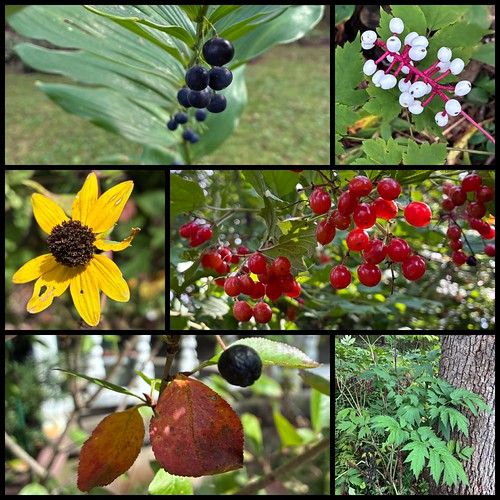
With that said, many native plants here are still attractive garden highlights--with colorful foliage, berries, and garden structure. They're holding their shape and adding beauty and seasonal wildlife value to the garden. In one way or another, all native plants benefit the local ecosystem, and some remain attractive, active highlights right through autumn and into the winter. While books could be written (and have been) about the ecosystem benefits of each native plant, I'm focusing here mainly on the garden aesthetics. Here are a few examples:

Solomon's Seal (Polygonatum biflorum): These attractive blue berries persist for months, and the arching stems resemble feathers in the wind.

White Baneberry (Actaea pachypoda): Bold, Maple-shaped leaves frame "doll's eyes" berries that branch out from bright red stalks.

Highbush Cranberry (Viburnum trilobum): This shrub holds its beauty through four seasons. The foliage shifts to multicolored shades of bronze to bright red in autumn, and the berries often persist into the winter.
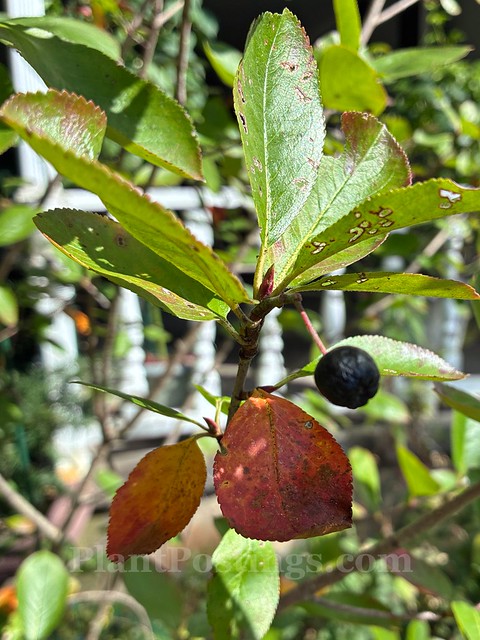
Chokeberry (Aronia melanocarpa): An excellent substitute for invasive Barberries (Berberis spp.), this shrub is still settling in here in my garden. It had a tough year with strange weather, but the edible, dark berries and the colorful foliage are worth the patience and effort. I will cut it way back in the spring to encourage more growth.

Black Cohosh (Actaea racemosa): This plant is the star of the garden in midsummer, with its tall, spiky, fluffy white flowers that tower over the understory plants. I've clipped the seeds in this particular grouping and placed them in the woods to encourage new plants. Even when clipped, they provide an attractive, shrub-like form next to the Oak trees.

False Sunflower (Heliopsis helianthoides): These plants bloom from mid-June through early October. What can I say? The pollinators enjoy the nectar, the birds eat the seeds, and the blooms offer garden beauty until the first frost.
With that said, many native plants here are still attractive garden highlights--with colorful foliage, berries, and garden structure. They're holding their shape and adding beauty and seasonal wildlife value to the garden. In one way or another, all native plants benefit the local ecosystem, and some remain attractive, active highlights right through autumn and into the winter. While books could be written (and have been) about the ecosystem benefits of each native plant, I'm focusing here mainly on the garden aesthetics. Here are a few examples:
Solomon's Seal (Polygonatum biflorum): These attractive blue berries persist for months, and the arching stems resemble feathers in the wind.
White Baneberry (Actaea pachypoda): Bold, Maple-shaped leaves frame "doll's eyes" berries that branch out from bright red stalks.
Highbush Cranberry (Viburnum trilobum): This shrub holds its beauty through four seasons. The foliage shifts to multicolored shades of bronze to bright red in autumn, and the berries often persist into the winter.
Chokeberry (Aronia melanocarpa): An excellent substitute for invasive Barberries (Berberis spp.), this shrub is still settling in here in my garden. It had a tough year with strange weather, but the edible, dark berries and the colorful foliage are worth the patience and effort. I will cut it way back in the spring to encourage more growth.
Black Cohosh (Actaea racemosa): This plant is the star of the garden in midsummer, with its tall, spiky, fluffy white flowers that tower over the understory plants. I've clipped the seeds in this particular grouping and placed them in the woods to encourage new plants. Even when clipped, they provide an attractive, shrub-like form next to the Oak trees.
False Sunflower (Heliopsis helianthoides): These plants bloom from mid-June through early October. What can I say? The pollinators enjoy the nectar, the birds eat the seeds, and the blooms offer garden beauty until the first frost.
These native plants and so many more make autumn a special time in our little corner of the world.

Natives, why fight what does well? I like that attitude. I've always loved Solomon's Seal, it's pretty and dramatic at the same time!
ReplyDeleteYes, exactly--especially when I like the plants so much, like Solomon's Seal. I'm thinking I'll help it establish more in a particular area, so I'm planning to harvest and plant more seeds.
DeleteSolomon's Seal remains highly attractive throughout the season, thanks to both its flowers and its berries. And what can be said about the look ( red stems + white berries ) of the actaea —which have amazing colors?!!
ReplyDeleteYes, the berries and foliage (and flowers in spring/summer) of both plants are attractive and beneficial. Win-win. :)
DeleteLoving the berries, especially those of the White Baneberry. Very striking.
ReplyDeleteI really like that plant, too. I want to help it spread by harvesting and planting more seeds.
DeleteFall is the season for berries and fruits--your birds and mammals are happy, I hope! Lovely photos, enjoy this wonderful time of year. Tina
ReplyDeleteThanks, Tina. September is a great month for gardening here and in your part of the country, too, right? Enjoy your autumn. :)
DeleteI think your idea of slowly replacing non-native plants over time is great. It's quite hard to know what to do here because the climate has changed so much that some natives are actually not doing so well anymore. Some gardeners are switching to more Mediterranean plants instead. I'll probably end up with a mix.
ReplyDeleteSolomon's Seal is definitely one on my wishlist. I didn't know it produced such attractive berries as well as pretty flowers!
Ah, yes, the shifting climate. That is playing a part in some of my decisions, too. Actually, the native plants seem to handle the dramatic shifts from dry to wet to hot to deep freeze better than some other plants. With that said, some of the native spring ephemerals have disappeared, although some take a break after a drought and then come back after a couple of years from seed. I'll definitely have a mix, and I'll always want to have plants like Hellebores and Rhubarb and others. All the Solomon's Seal here were planted by nature, but I think I'm going to plant some seeds in a special place for next year. :)
DeleteIt’s fruit and seed season, pretty captures of what fall brings. I have a couple black cohosh, I love the blooms in summer.
ReplyDeleteHi Tom: Yes, the Black Cohosh is special, isn't it? It has so many nicknames, too. I often call it Bugbane, too. I know its genus changed from Cimicifuga to Actaea a few years ago. Such a fun plant, with so many names!
DeleteIt does help to have a good palette of native plants to begin with; I feel the UK has a comparatively limited range of garden worthy natives. Do you stick with plants native to your local area or cast the net a bit wider?
ReplyDeleteHi Jim: Many of us have "borrowed" garden ideas from the UK and other parts of the world. I would find it hard to give up Hellebores, for example. I tend to go with local natives most of the time, mainly because of our cold winter climate, but I've also added several in this garden from places not too far away and not technically native right in this spot. For example, there's a Prairie Rose that is native about 85 kilometers south of here that has a special place in my heart and garden. Thanks for hosting "Six on Saturday"!
DeleteKudos to you for making good use of your native plants, Beth. The Viburnum is especially attractive. I've failed to use many local natives in my own garden as our chaparral isn't particularly attractive in most respects. (Ceanothus, aka California lilac, is one of the few exceptions.) As SoCal is considered a Mediterranean climate, I rely more heavily on the plants adapted to that climate, hence all the Mediterranean, South African and Australian plants in my garden.
ReplyDeleteThanks, Kris. I appreciate all the amazing plants you can grow in your garden! Many of them are grown as annuals here, which makes gardening especially fun and colorful here in the summer. I'm not an expert on the trends and science behind invasive plant species, but the ones that seem to be most problematic here are those that can survive our brutal winters and then displace native plants that need space to grow. Climate change seems to be accelerating this effect, in some cases.
DeleteI planted solomons seal three years ago in my pond garden. I love it.
ReplyDeleteI want to get a highbush cranberry.
Solomon's Seal was here when we moved in decades ago. It has shifted around and volunteered itself in some spots, but I've never transplanted or planted any, with the exception of seeds this year. And the Highbush Cranberry shrubs were volunteers. :)
DeleteThe sunlight shining through the Viburnum trilobum berries is so cheery. You've found a lot to treasure in the autumnal garden.
ReplyDeleteI just harvested some Viburnum berries today. I'm planning to dry them like cranberries for craisins. We'll see how that works out. :)
DeleteThese are plants I know! Mostly from the Black Hills.
ReplyDeleteThe Black Hills...lovely destination. We've enjoyed several trips to and through that area. :)
DeleteI absolutely adore natives because they just keep giving.
ReplyDeleteSo true, Donna. It's fun and fascinating to intentionally encourage and plant native plants in the garden.
Delete