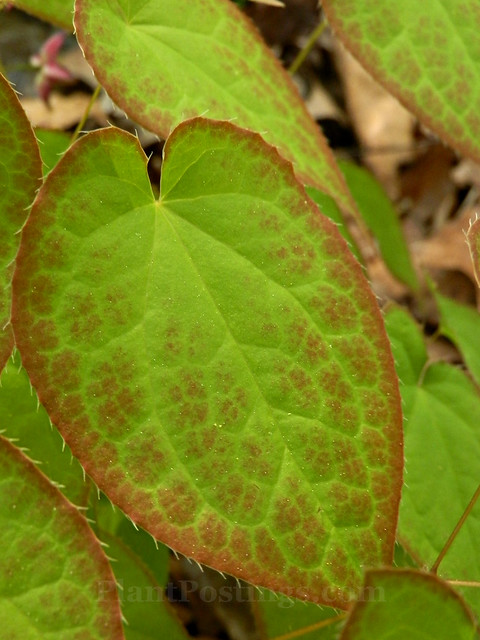
Showing posts with label colorful foliage. Show all posts

September 02, 2024

It's Only Foliage in a Vase on Monday

arrangement 1

The garden is still bursting with blooms!

But I needed to trim some of the foliage on my potted plants, so I thought it might be fun to do a "foliage only" arrangement. I clipped, clipped away out in the garden, gave it a little thought, and here's what I came up with. The "foliage only" grouping includes:

Coleus 1

Coleus 2

Coleus 3

Coleus 4

Several mixed cultivars of Coleus (C. scutellarioides) that I grow in pots;

Hydrangea macrophylla

The wonderful framing element of Hydrangea foliage (H. macrophylla);

Jacobaea maritima

A couple sprigs of the sprightly Dusty Miller (Jacobaea maritima);

Cosmos bipinnatus

A fun, squiggly spot of Cosmos (C. bipinnatus);

Hypoestes phyllostachya

And several groupings of Polka Dot Plant (Hypoestes phyllostachya), to add some character.

arrangement 2

This was a fun one! I might try to do this more often in the future...it's a slightly more challenging departure from the equally delightful bloom-focused arrangements.

Thanks so much to Cathy for hosting In a Vase on Monday!

January 22, 2022

Happy Observations: Overwintered Potted Plants

oxalis 2

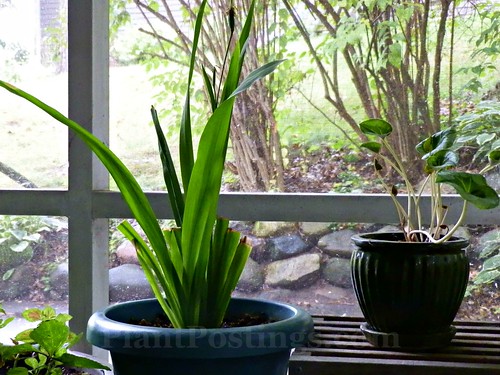
It's about this time of year that I rely on the joy of the potted plants in the sunroom to lift my winter spirits and help me look forward to spring. Several developments have me optimistic for the growing season ahead.

autumnale

This is the second year I've brought in a pot of Fuchsia 'Autumnale' for replanting next spring. It's doing well and branching out a bit with new growth. Over time, it has the most exquisite variegated foliage that changes with the seasons and the light.

purple shamrock

Purple Shamrock (Oxalis triangularis) has held up for many years of indoor/outdoor movement. Its foliage is always pleasing to the eye. No signs of buds or blooms yet, but they'll follow in the weeks ahead.

passionflower

This is my first year successfully growing Purple Passionflower (Passiflora incarnata). I left some plants outdoors, heavily mulched, and I brought in the potted ones. The latter are sprouting new growth. This will be a fun comparison.

lantana

This is also the first time I've overwintered Lantanas. This one, L. camara 'Bandana Rose,' is a little brown around the edges, but showing signs of new growth.

marinka

My favorite Fuchsia, 'Marinka,' still has ripening fruits from the previous growing season. These potted plants prefer the humid, warm weather, but they're holding their own in the cool sunroom, after several years of this seasonal routine.

sedum

This Sedum hybrid was part of a gift arrangement, so I don't know the variety. But I notice it's budding, so blooms will soon follow. Yay.

oxalis 1

Finally, Oxalis vulcanicola 'Zinfandel' has been blooming continuously since I purchased it last spring. The flowers sparkle when backlit by the sunny winter landscape out the window (first photo). And the buds, blooms, and foliage are all cheery, colorful signs of hope.

August 16, 2021

Pots Full of Form and Color

anchor pot swallowtail

For several days in a row, this Eastern tiger swallowtail spent hours nectaring on potted Impatiens (I. capensis) 'Accent Burgundy.' It was a beautiful sight to see, and the butterfly seemed very tame and contented.

When I gathered photos for my last post about "likes" and "dislikes," I went a little overboard. So, I separated out the photos of the potted plants. For the most part, I've been pleased with their performance and results. Of course, potted plants are watered regularly, so they benefited from extra care during the drought.

anchor pot in back

The potted Impatiens form a focal point in the back garden. They've really filled in nicely.

anchor pot plants 1

In the pot with them are Oxalis (O. vulcanicola) 'Zinfandel,' which are not hardy in my cold climate. So I might bring some inside, as I do with my Purple Shamrocks (O. trangularis).

anchor pot plants 2

And on the sides of the pot, Bush Violets (Browallia) 'Endless Flirtation.'

wild senna

Behind them, adjacent to the wire trellis and the Oak tree, is a patch of Wild Senna (S. hebecarpa) (not potted) that I planted just a couple of years ago. I think it likes this spot.

impatiens and sw potato vine

I included the 'Accent Burgundy' Impatiens in several other pots, too, including this one with Sweet Potato Vines (Ipomoea batatas) 'Sweet Caroline Bewitched After Midnight' and 'Sweet Caroline Light Green.'

impatiens and asparagus fern

Impatiens 'Accent Bright Eye' is also happy, with its companion, Asparagus Fern (A. densiflorus) 'Sprengeri.'

impatiens with friends

'Accent Bright Eye' also combines nicely with Lantana (L. camara) 'Bandana Rose' and some Marigolds (not blooming in this photo).

ng impatiens

New Guinea Impatiens (I. hawkeri) 'Magnum Bright Purple' also was a favorite spot for the swallowtail. I have three lush, full pots of this variety, and all three are now blooming more fully than the photos here. I love the foliage on this plant, too.

ng impatiens and coleus

More New Guinea Impatiens with various Coleus hybrids.
 
fun combo

And Coleus paired with the Oxalis.

passionflower

I'm pleased with the progress of Purple Passionflower (Passiflora incarnata), potted here and along a trellis on the side of the house. All were planted from seed. I'll take this one into the cool sunroom for the winter and leave the others in the soil outdoors. It will be a fun experiment. Maybe we'll see flowers and fruit next summer.

potted fun

Two fun pots at the westside base of the sunroom: Fuchsia (F. triphylla) 'Gartenmeister Bonstedt' and a Caladium (C. bicolor).

hyacinth bean vine

I've grown Hyacinth Bean Vine (Lalab purpurea) from seed for many years, and it seems very happy in this pot with rabbit-proofing wire at the base.

hyacinth spider

The foliage is as pretty as the flowers, which are sparse in the shade.

hyacinth buds

I always get some flowers from Hyacinth Bean Vine, but they're developing later this year, probably because the trees leafed out very early in the spring.

fuchsia pots

My favorite Fuchsia hybrid is 'Marinka,' and I've overwintered these two pots in the sunroom for several years now. I clip them back when I bring them in, and they fill out nicely when they go back out in late spring.

fuchsia marinka

The hummingbirds like them, too. I'll have to try to get photos of the hummers nectaring here.

I've been happy with these and several other potted arrangements this growing season. They brighten my day when I walk out of the house. Maybe I'll add even more pots next year...

January 12, 2017

Plant of the Month: Florist's Cyclamen

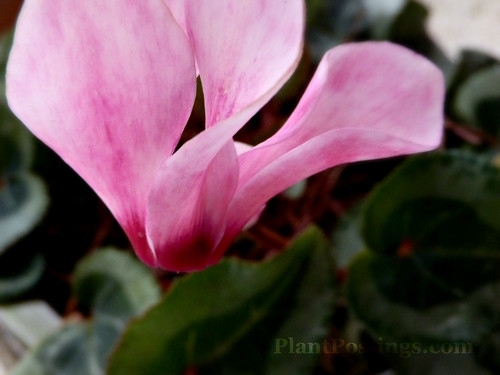
flower 1

I write this post not with any pretense about success in growing indoor potted plants. On the contrary, my record with them, in general, is not good.

I can remember my dear grandmother's home filled with African violets that spanned the color range, and she was able to keep them growing for years on end, with repeat full and lush blooms. She may have had a Cyclamen or a few other blooming plants among her collection--I don't recall.

My experience is not as impressive. Historically, I've killed more indoor potted plants than I'd care to share here. But that doesn't stop me from trying. And in recent years, I've had more success (or perhaps luck). One of the plants that has surprised me with its longevity and lush growth is a Cyclamen plant I picked up four years ago.

flower 2

Most potted Cyclamens are florist cultivars of C. persicum, a species native to the Middle East, Northern Africa, and Eastern Europe. The species has a limited range of allowable conditions in the wild, which probably accounts for its persnickety temperament.

Now, mind you, I don't necessarily follow the rules when it comes to dealing with potted plants--particularly those that go dormant. (Visit this link to learn more about conditions preferred by potted Cyclamen plants.)  I don't have the patience to put them away in a dark room, water them at a specific time, hang them upside down, and do the hokey-pokey. But for the purposes of documentation, here are the conditions and steps I've followed that have kept this little Cyclamen plant going and flourishing since 2013:

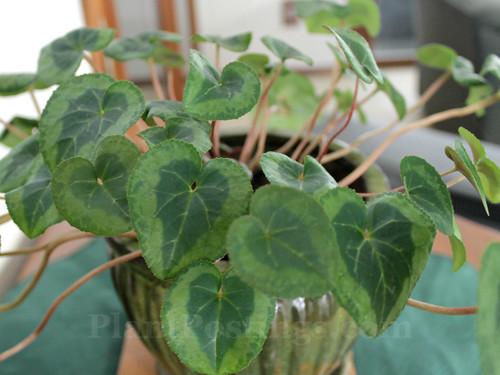
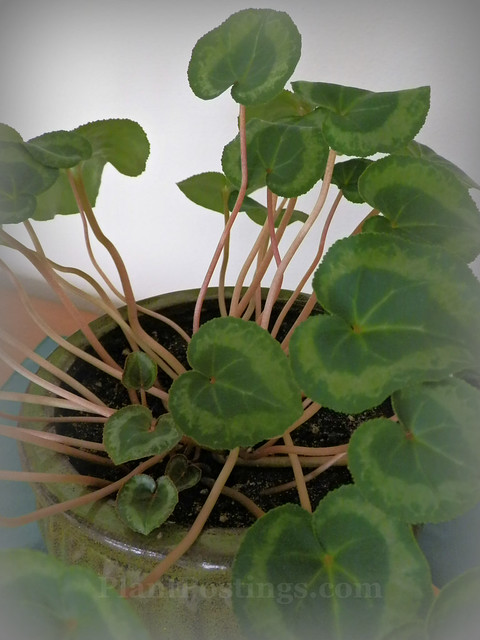
foliage 2

• I first transplanted my Cyclamen from its plastic retail container to the ceramic pot it inhabits to this day. I've never transplanted it again, though many recommend that practice annually after summer dormancy. This particular container has good drainage, but I used only regular potting soil with small pebbles on top for mulch/decoration.

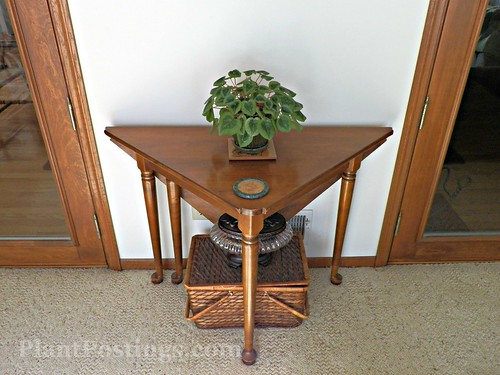
winter

• During the winter, the plant lives on a small table on the north side of the sunroom, which faces south. Here, it receives indirect light from dawn until dusk. The room is partially heated, but is closed off from the rest of the house. Daytime temperatures range from about 50F to 70F, depending on the sunlight, the day length, and the outdoor air temperatures/wind conditions. Nighttime temps range from about 38F to 50F. The room is more humid than the rest of the house, but on dry, cold days I do mist the plants to maintain slightly higher humidity.

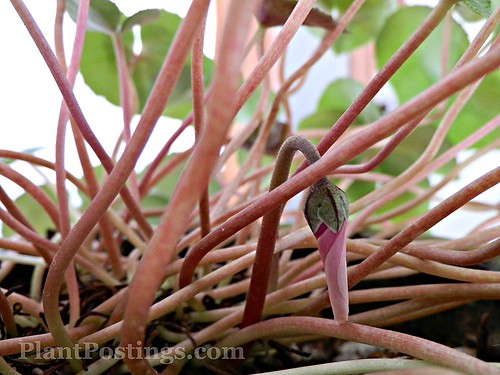
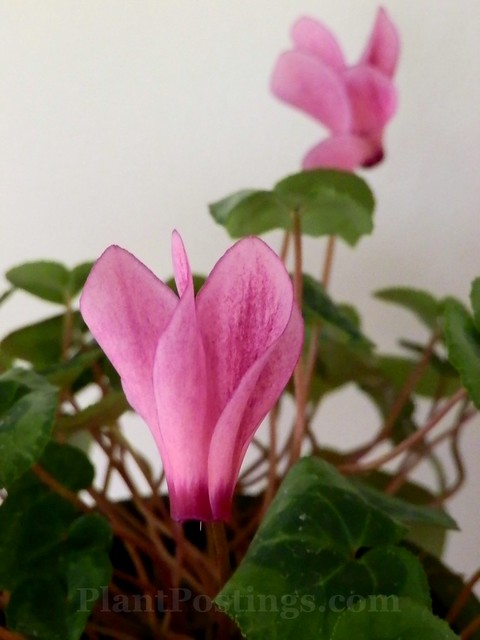
bud

Bloom time for my little Cyclamen plant begins anywhere from early January to mid-February. I don't know why it varies--probably because I don't follow the rules. It's always exciting to see the first budding stems pop out of the soil. At first, they look very much like the foliage stems, until you begin to see the twirled pink shape of the buds.

The plant blooms, generally, through the early spring. The foliage continues to flourish until early summer.

screen porch

• I place the plant outside (in a shady spot protected from heavy rainfall) with most of my other potted plants as soon as nighttime temperatures consistently remain above about 40F--generally sometime in early May. If we have a very cold night with a frost predicted, I move the plants to a warm porch and cover them. Usually, by mid-May, we're beyond the threat of nighttime frost, and I do a jig.

• When the foliage begins to wither and fall off, I slowly reduce watering. It is at this point, I believe, that many people give up on potted Cyclamens and throw them out (because I almost did, myself, more than once). But I encourage you to simply ignore the plant for a few months. A little water is OK, but the plant is now dormant and is better off neglected for a bit so it can rest during the heat of the summer.

In some years, the Cyclamen retains a few leaves even through the summer. In other years, it entirely loses its leaves and I can't believe there's a chance it will come back. But then it does! Tiny new shoots emerge from the soil and begin to fill in.

foliage 1

• Before the first frost, I bring my plants indoors for the winter. For me, this happens sometime between early and mid-October. By this point, the Cyclamen is starting to look like a lovely potted foliage plant, perfect as a holiday accent piece.

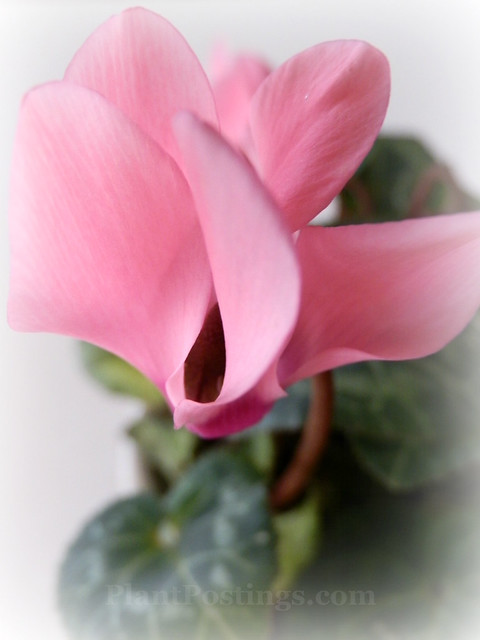
flower 3

And so the cycle continues. If you've ever tried to grow florist's Cyclamen and have given up, I encourage you to try again. It's easier than you might think, and the hardest part is having faith it will resurrect from its summer dormancy. When it does, it's hard to describe the thrill of seeing new life at a time when most other plants are going dormant.

flower 4

January 14, 2016

Why Grow Epimediums?

rubrum spring

Do you prize Epimediums more for their foliage or for their blooms?

For me, it depends--based on the season, the siting, and the species or hybrid.

warleyense flower 2

Many years ago, Epimediums jumped to the top of my "wish" list: because they're distinctive ground-cover plants, they thrive in dry shade, they have attractive foliage, and (supposedly) they're deer- and rabbit-resistant (more on that later).

I held off for a long time because I've tried to add more native plants to my garden. (Epimedium species are native to Asia and the Mediterranean).

A few years ago, I couldn't resist. I decided to add two Epimediums to a garden plot near the house that features mostly non-native, rabbit-resistant and rabbit-repellent plants. This is a contained area, surrounded by sidewalks and a rock wall: The plants won't bolt. In 2014, I added a third Epimedium.
neighbors
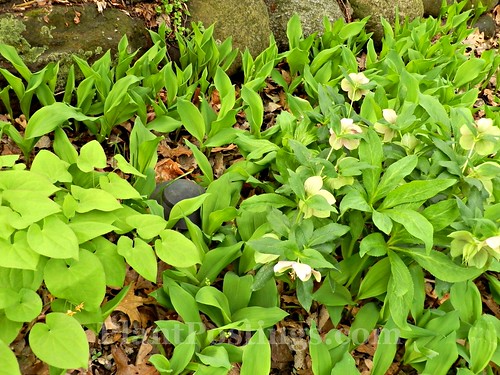
Epimedium x warleyense on left, Helleborus orientalis on right; mixed with Convallaria majalis.

It's a mild microclimate anchored by that rock wall. Neighboring plants include Hellebores and Convallarias (Lily-of-the-Valley), among others. The entire area is probably more like a windless USDA zone 6, and the temperatures are more constant and mild than the rest of my garden. The Epimediums are happy here.

The first two survived the polar vortex of 2013-2014, and the third survived last year's brutal February. The Brooklyn Botanic Garden notes that most Epimediums are hardy to zone 5. (You can learn more about Epimediums, in general, by visiting the link.) I love the nicknames of these plants: Barrenwort, Bishop's Hat, Fairy Wings, Horny Goat Weed, Rowdy Lamb Herb ... and others.

So, back to my original question: foliage or blooms? Well, here's my take, based on my limited experience with the three cultivars in my garden:
creeping yellow
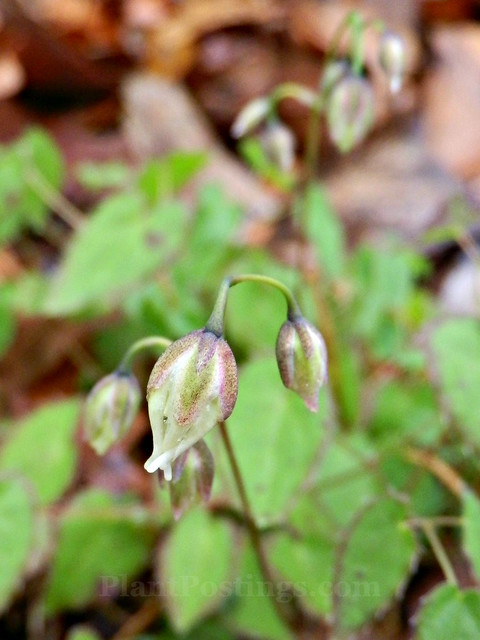
E. grandiflorum 'Creeping Yellow'

One of my first purchases was 'Creeping Yellow.' I'm not sure why "yellow" is in the name. Neither the blooms nor the foliage are particularly yellow.

creeping yellow bud

The buds on this one are luscious, and at a certain point, the flower spurs crisscross in a delightful dance.
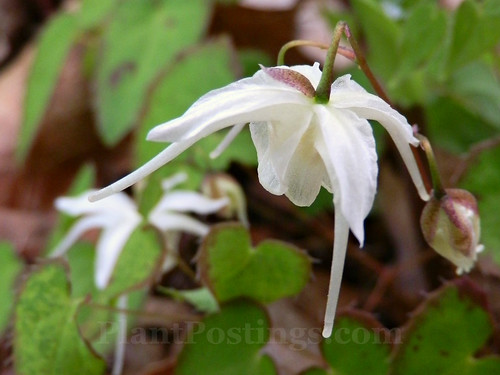
creeping yellow flower

The blooms are ethereal and do, indeed, resemble fairy wings.
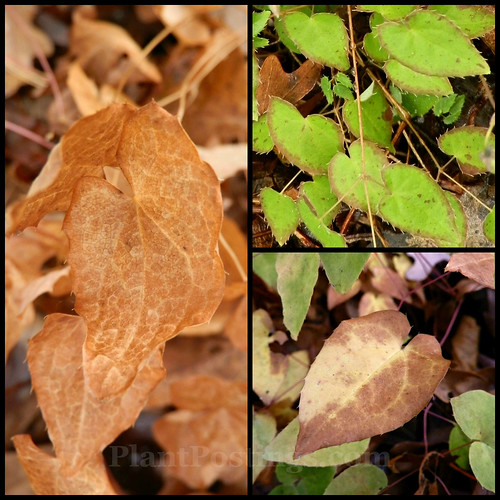
creeping yellow foliage
'Creeping Yellow' foliage, clockwise from top right: spring, autumn, late autumn.

Some sources suggest this plant is hardy to zone 4, but in my garden--even in that microclimate location--this is the only Epimedium of the three that is not evergreen.

The foliage is tiny. Leaves begin a beautiful bright green with russet edges. During the summer, the edges blend to green; in the fall the leaves have an attractive speckled appearance; and by late fall the entire leaf surface forms a coppery color and falls off. This plant goes entirely dormant in my garden, and new growth appears as tiny new shoots in the early spring.
rubrum
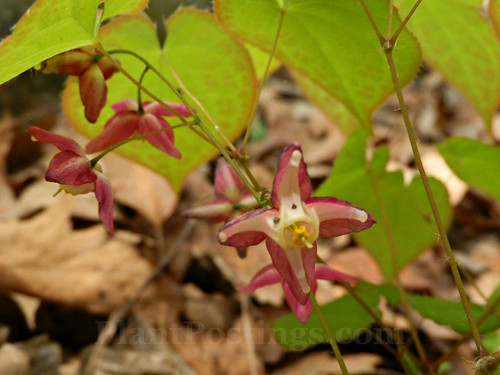
E. x rubrum

E. x rubrum is my most recent purchase. Its flowers are a little more complex in color, but with shorter spurs.
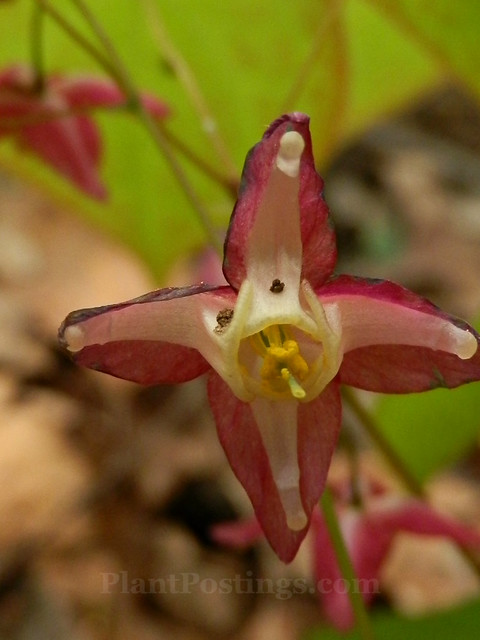
rubrum flower

Like the other Epimediums, rubrum's blooms form under the foliage and arc downward, so you need to peer closely to see them ... certainly worth the effort.
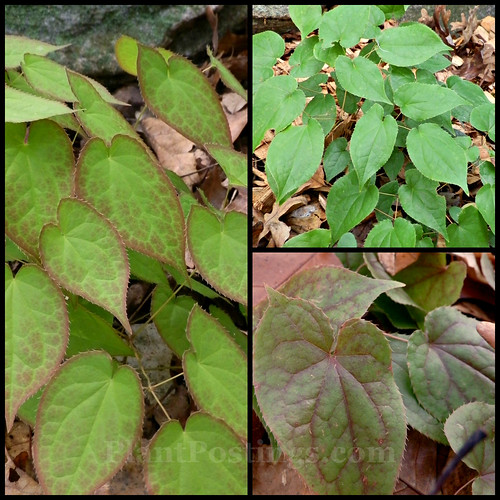
rubrum foliage
Rubrum foliage, clockwise from left: spring, summer, fall.

Rubrum has more distinctive foliage during the spring and fall, and it seems to stay semi-evergreen through the winter. I find it interesting that the red color fades in summer and then reappears in the veins of the foliage in autumn.
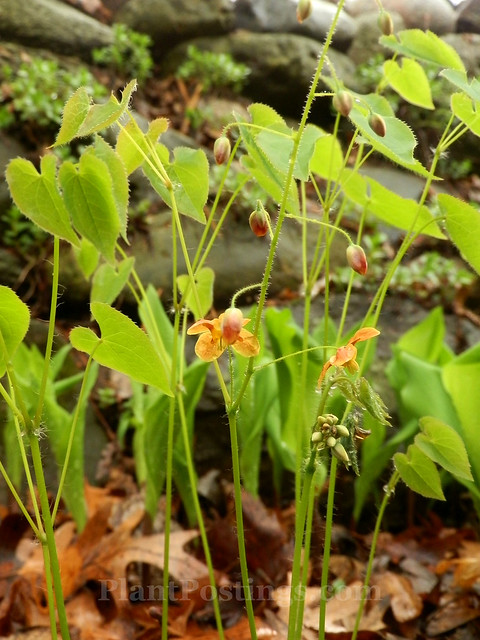
warleyense
E. x warleyense

Finally, E. x warleyense is a taller hybrid, with more prominent orange buds and flowers that shoot up through the foliage.
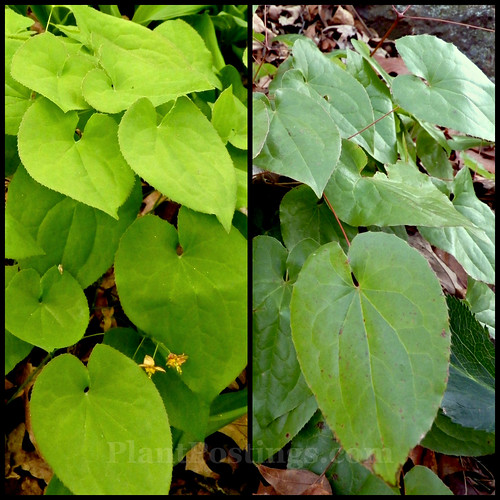
warleyense foliage
Warleyense foliage: spring on left, late autumn on right.

Warleyense foliage remains green throughout the year--starting bright chartreuse green and darkening to a deep green with a shiny surface. When the snow melts, the leaves remain in late winter/early spring.

This plant is by far the healthiest Epimedium in my garden and I've already divided it and planted it in another spot. Interestingly, rabbits haven't touched warleyense in its original location, but they entirely consumed the leaves off the transplant!
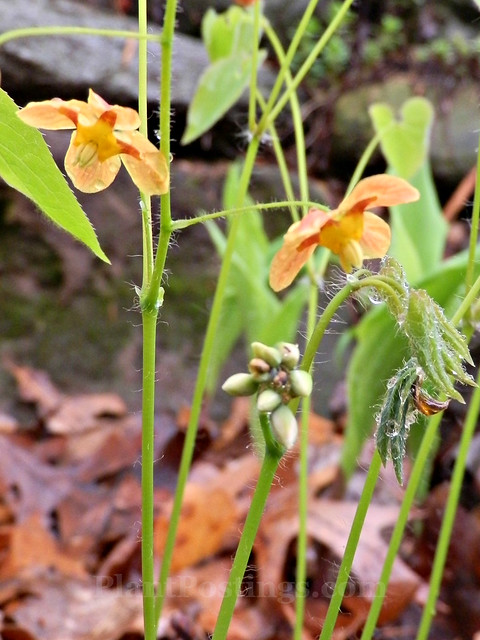
warleyense bud

Not to worry: New buds, flowers, and foliage will emerge in the spring, and I'll clip off the old foliage anyway.

warleyense flower 1

The blooms of this one are my delight!
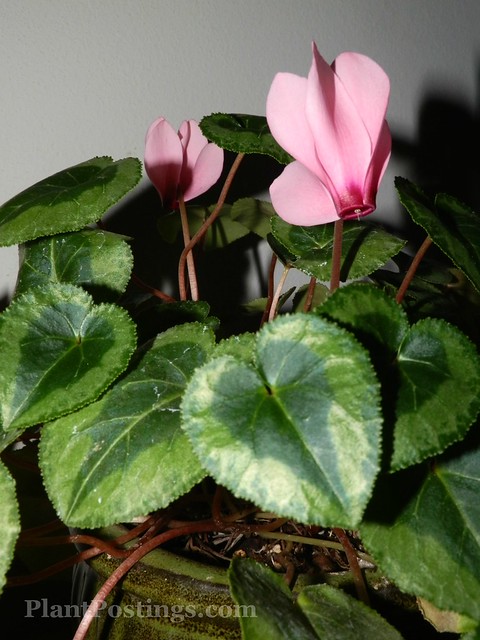
One thing to keep in mind if you're new to Epimediums: The blooms and stems are tiny and the plants seem fragile, but they're much sturdier than they appear.

How about you? Do you grow Epimediums? Which species and hybrids are your favorites, and why?

Since my garden is currently dormant, it's probably inappropriate to link to Garden Bloggers Bloom Day at May Dreams Gardens and Foliage Follow-Up at Digging, but I add their links here. Check them out on the 15th and 16th: It's a great way to beat the winter doldrums!