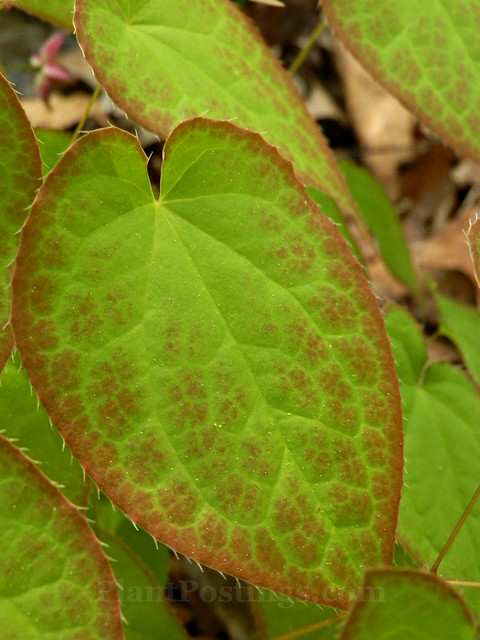
Do you prize Epimediums more for their foliage or for their blooms?
For me, it depends--based on the season, the siting, and the species or hybrid.

Many years ago, Epimediums jumped to the top of my "wish" list: because they're distinctive ground-cover plants, they thrive in dry shade, they have attractive foliage, and (supposedly) they're deer- and rabbit-resistant (more on that later).
I held off for a long time because I've tried to add more native plants to my garden. (Epimedium species are native to Asia and the Mediterranean).
A few years ago, I couldn't resist. I decided to add two Epimediums to a garden plot near the house that features mostly non-native, rabbit-resistant and rabbit-repellent plants. This is a contained area, surrounded by sidewalks and a rock wall: The plants won't bolt. In 2014, I added a third Epimedium.
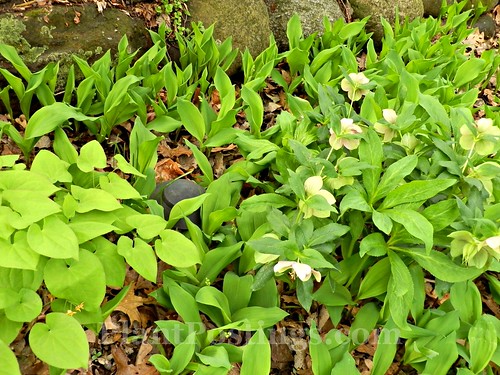 |
| Epimedium x warleyense on left, Helleborus orientalis on right; mixed with Convallaria majalis. |
It's a mild microclimate anchored by that rock wall. Neighboring plants include Hellebores and Convallarias (Lily-of-the-Valley), among others. The entire area is probably more like a windless USDA zone 6, and the temperatures are more constant and mild than the rest of my garden. The Epimediums are happy here.
The first two survived the polar vortex of 2013-2014, and the third survived last year's brutal February. The Brooklyn Botanic Garden notes that most Epimediums are hardy to zone 5. (You can learn more about Epimediums, in general, by visiting the link.) I love the nicknames of these plants: Barrenwort, Bishop's Hat, Fairy Wings, Horny Goat Weed, Rowdy Lamb Herb ... and others.
So, back to my original question: foliage or blooms? Well, here's my take, based on my limited experience with the three cultivars in my garden:
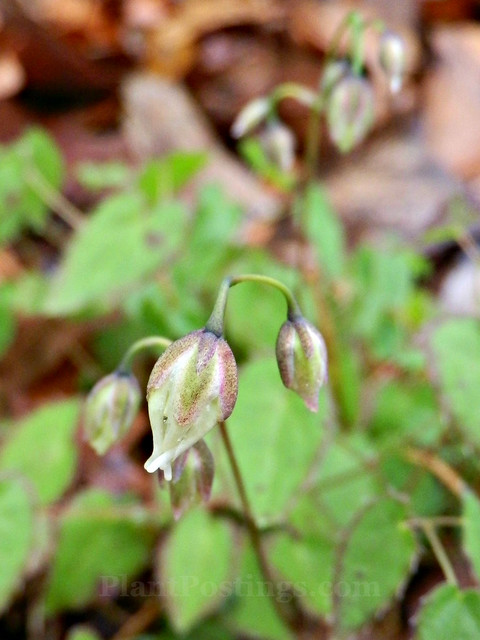 |
| E. grandiflorum 'Creeping Yellow' |
One of my first purchases was 'Creeping Yellow.' I'm not sure why "yellow" is in the name. Neither the blooms nor the foliage are particularly yellow.

The buds on this one are luscious, and at a certain point, the flower spurs crisscross in a delightful dance.
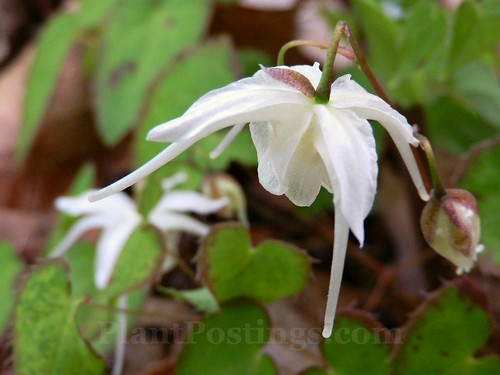
The blooms are ethereal and do, indeed, resemble fairy wings.
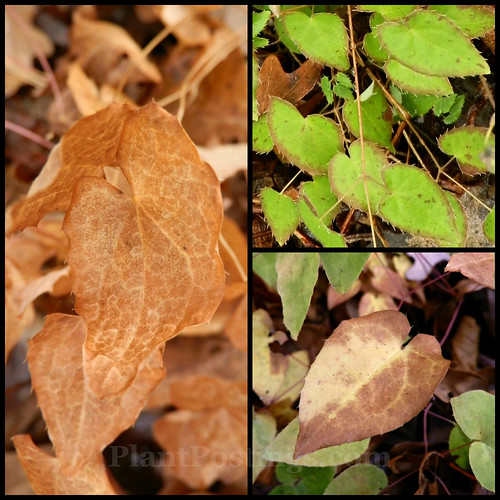 |
| 'Creeping Yellow' foliage, clockwise from top right: spring, autumn, late autumn. |
Some sources suggest this plant is hardy to zone 4, but in my garden--even in that microclimate location--this is the only Epimedium of the three that is not evergreen.
The foliage is tiny. Leaves begin a beautiful bright green with russet edges. During the summer, the edges blend to green; in the fall the leaves have an attractive speckled appearance; and by late fall the entire leaf surface forms a coppery color and falls off. This plant goes entirely dormant in my garden, and new growth appears as tiny new shoots in the early spring.
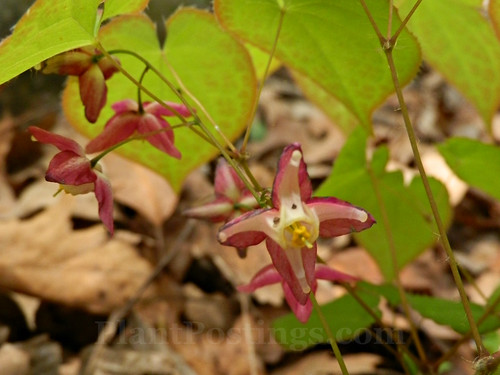 |
| E. x rubrum |
E. x rubrum is my most recent purchase. Its flowers are a little more complex in color, but with shorter spurs.
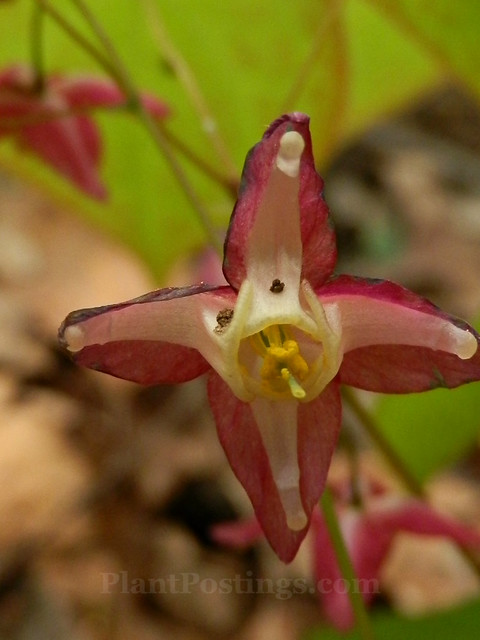
Like the other Epimediums, rubrum's blooms form under the foliage and arc downward, so you need to peer closely to see them ... certainly worth the effort.
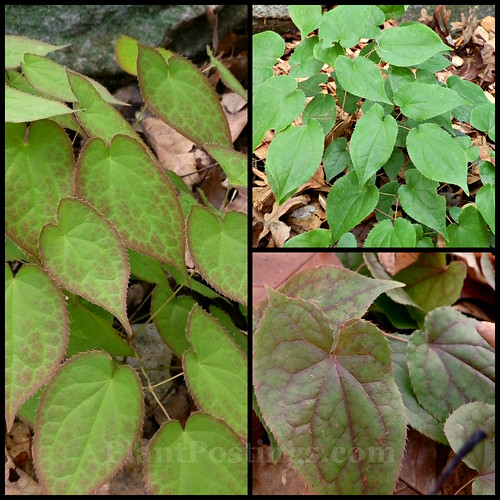 |
| Rubrum foliage, clockwise from left: spring, summer, fall. |
Rubrum has more distinctive foliage during the spring and fall, and it seems to stay semi-evergreen through the winter. I find it interesting that the red color fades in summer and then reappears in the veins of the foliage in autumn.
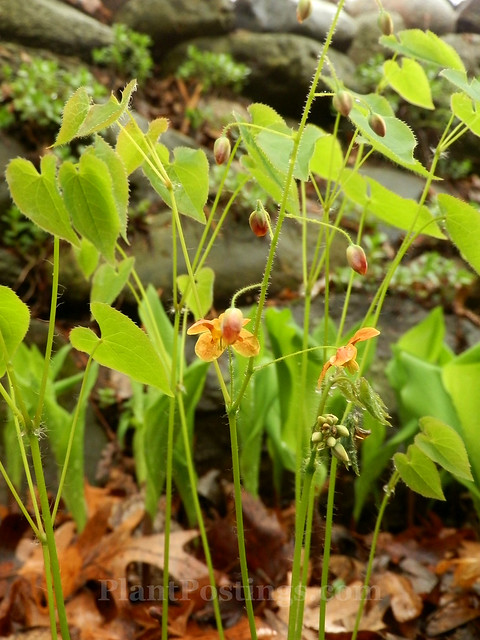 |
| E. x warleyense |
Finally, E. x warleyense is a taller hybrid, with more prominent orange buds and flowers that shoot up through the foliage.
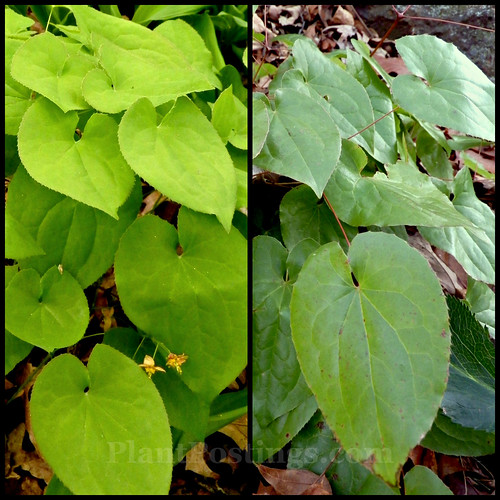 |
| Warleyense foliage: spring on left, late autumn on right. |
Warleyense foliage remains green throughout the year--starting bright chartreuse green and darkening to a deep green with a shiny surface. When the snow melts, the leaves remain in late winter/early spring.
This plant is by far the healthiest Epimedium in my garden and I've already divided it and planted it in another spot. Interestingly, rabbits haven't touched warleyense in its original location, but they entirely consumed the leaves off the transplant!
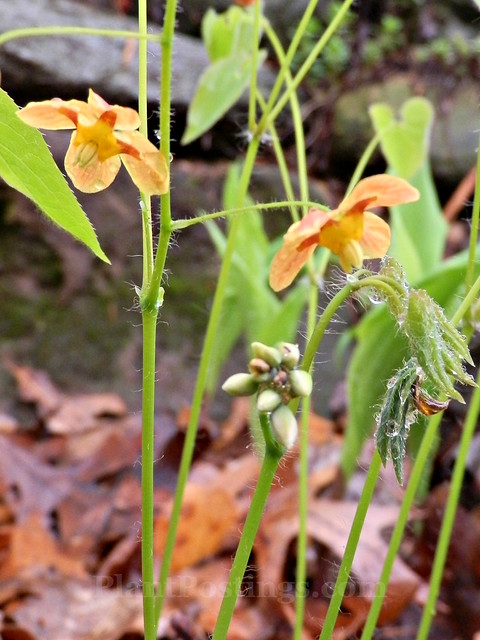
Not to worry: New buds, flowers, and foliage will emerge in the spring, and I'll clip off the old foliage anyway.

The blooms of this one are my delight!
One thing to keep in mind if you're new to Epimediums: The blooms and stems are tiny and the plants seem fragile, but they're much sturdier than they appear.
How about you? Do you grow Epimediums? Which species and hybrids are your favorites, and why?
Since my garden is currently dormant, it's probably inappropriate to link to Garden Bloggers Bloom Day at May Dreams Gardens and Foliage Follow-Up at Digging, but I add their links here. Check them out on the 15th and 16th: It's a great way to beat the winter doldrums!
