
January 25, 2017

January 15, 2017
January Blooms and Foliage

It's mid-winter and, believe it or not, I have a few blooms and foliage to report for Garden Blogger's Bloom Day and Foliage Follow-Up. A Dutch Hyacinth (H. orientalis) I planted two years ago skipped last year and decided to bloom this year amidst the English Ivy in the same pot.

The Cyclamen (C. persicum) I covered in my last post has new buds.

And a pot full of variegated foliage.

Purple Shamrock (Oxalis triangularis) is sporting delicate white blooms.

Along with its signature purple triangular leaves.

Some of the pots I'm overwintering include a few Marigolds (Tagetes spp.).

And the Meyer Lemon has new flower buds.

And tender, unfurling new leaves.
What's blooming and growing in your garden and your home? Check out flower and foliage posts from around the world at May Dreams Gardens and Digging.
January 12, 2017
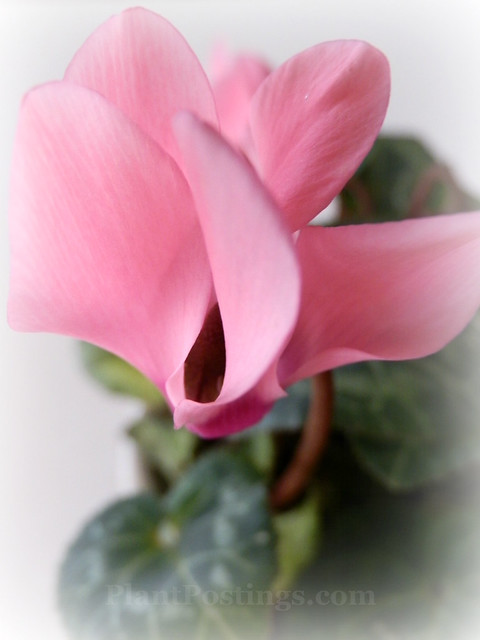
Plant of the Month: Florist's Cyclamen
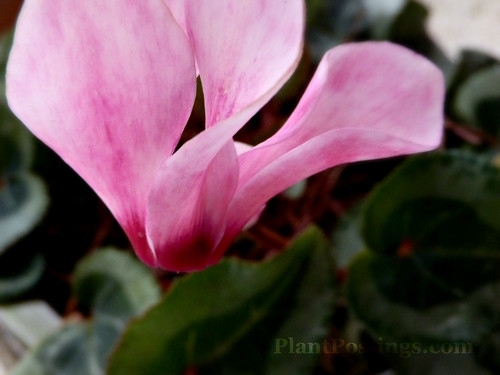
I write this post not with any pretense about success in growing indoor potted plants. On the contrary, my record with them, in general, is not good.
I can remember my dear grandmother's home filled with African violets that spanned the color range, and she was able to keep them growing for years on end, with repeat full and lush blooms. She may have had a Cyclamen or a few other blooming plants among her collection--I don't recall.
My experience is not as impressive. Historically, I've killed more indoor potted plants than I'd care to share here. But that doesn't stop me from trying. And in recent years, I've had more success (or perhaps luck). One of the plants that has surprised me with its longevity and lush growth is a Cyclamen plant I picked up four years ago.
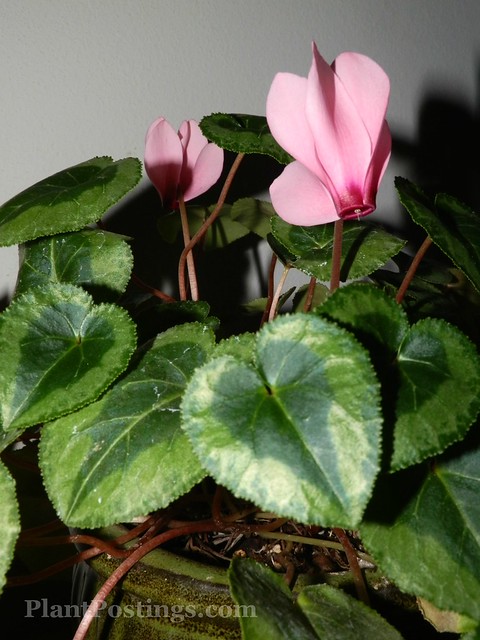
Most potted Cyclamens are florist cultivars of C. persicum, a species native to the Middle East, Northern Africa, and Eastern Europe. The species has a limited range of allowable conditions in the wild, which probably accounts for its persnickety temperament.
Now, mind you, I don't necessarily follow the rules when it comes to dealing with potted plants--particularly those that go dormant. (Visit this link to learn more about conditions preferred by potted Cyclamen plants.) I don't have the patience to put them away in a dark room, water them at a specific time, hang them upside down, and do the hokey-pokey. But for the purposes of documentation, here are the conditions and steps I've followed that have kept this little Cyclamen plant going and flourishing since 2013:
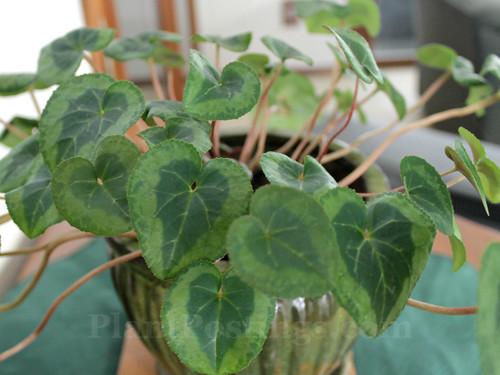
• I first transplanted my Cyclamen from its plastic retail container to the ceramic pot it inhabits to this day. I've never transplanted it again, though many recommend that practice annually after summer dormancy. This particular container has good drainage, but I used only regular potting soil with small pebbles on top for mulch/decoration.
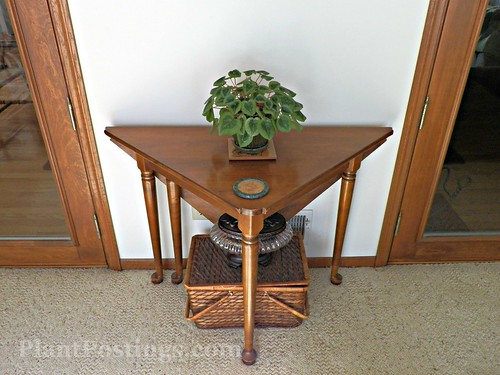
• During the winter, the plant lives on a small table on the north side of the sunroom, which faces south. Here, it receives indirect light from dawn until dusk. The room is partially heated, but is closed off from the rest of the house. Daytime temperatures range from about 50F to 70F, depending on the sunlight, the day length, and the outdoor air temperatures/wind conditions. Nighttime temps range from about 38F to 50F. The room is more humid than the rest of the house, but on dry, cold days I do mist the plants to maintain slightly higher humidity.
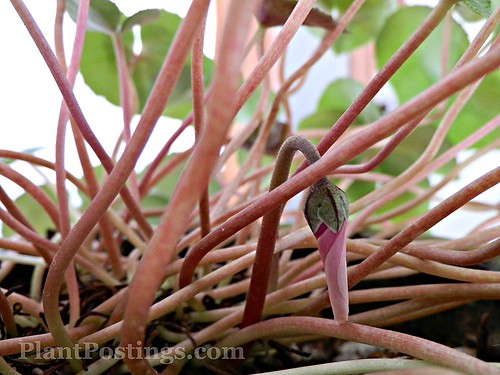
Bloom time for my little Cyclamen plant begins anywhere from early January to mid-February. I don't know why it varies--probably because I don't follow the rules. It's always exciting to see the first budding stems pop out of the soil. At first, they look very much like the foliage stems, until you begin to see the twirled pink shape of the buds.
The plant blooms, generally, through the early spring. The foliage continues to flourish until early summer.
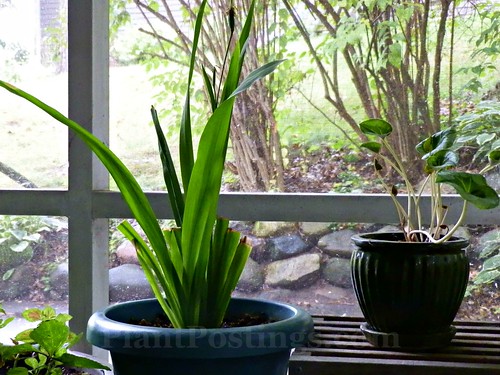
• I place the plant outside (in a shady spot protected from heavy rainfall) with most of my other potted plants as soon as nighttime temperatures consistently remain above about 40F--generally sometime in early May. If we have a very cold night with a frost predicted, I move the plants to a warm porch and cover them. Usually, by mid-May, we're beyond the threat of nighttime frost, and I do a jig.
• When the foliage begins to wither and fall off, I slowly reduce watering. It is at this point, I believe, that many people give up on potted Cyclamens and throw them out (because I almost did, myself, more than once). But I encourage you to simply ignore the plant for a few months. A little water is OK, but the plant is now dormant and is better off neglected for a bit so it can rest during the heat of the summer.
In some years, the Cyclamen retains a few leaves even through the summer. In other years, it entirely loses its leaves and I can't believe there's a chance it will come back. But then it does! Tiny new shoots emerge from the soil and begin to fill in.
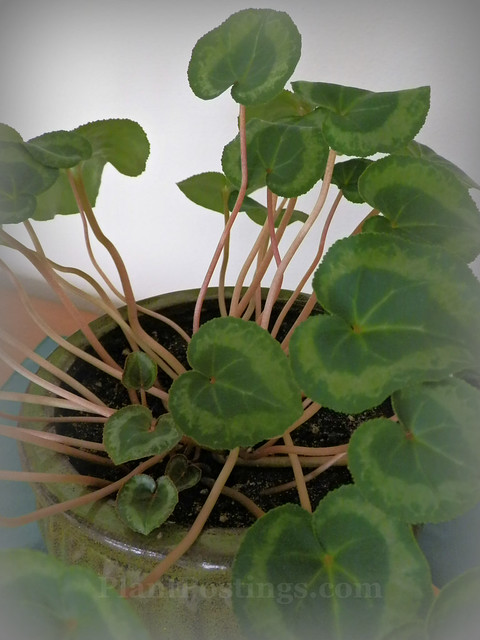
• Before the first frost, I bring my plants indoors for the winter. For me, this happens sometime between early and mid-October. By this point, the Cyclamen is starting to look like a lovely potted foliage plant, perfect as a holiday accent piece.
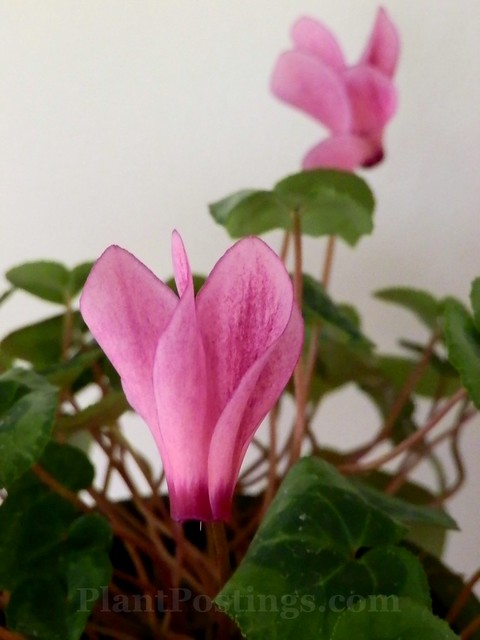
And so the cycle continues. If you've ever tried to grow florist's Cyclamen and have given up, I encourage you to try again. It's easier than you might think, and the hardest part is having faith it will resurrect from its summer dormancy. When it does, it's hard to describe the thrill of seeing new life at a time when most other plants are going dormant.
January 06, 2017
A Peaceful Hike at Durward's Glen

I miss warm-weather hikes. As winter settles in, I'm dreaming about the trails that call me during the spring, summer, and fall.
One of our favorite family hiking destinations over the years has been Durward's Glen, 30 miles north of Madison in the Baraboo Hills. The 40-acre property is on the National Register of Historic Places and is open to the public daily, from dawn until dusk. It's had a rich tradition of contemplative, physical, and spiritual renewal since the mid-19th Century. (Visit this link for more on the history of Durward's Glen.)
Photos in this post were from a late summer hike a couple of years ago.

The Glen, itself, is punctuated by a gentle stream, a peaceful woodland, and fascinating rock ridges.

During the growing season, wildflowers, like this Cutleaf Coneflower (Rudbeckia laciniata), greet visitors along the paths.

The main loop is a relatively easy hike for families. A simple bridge crosses the stream, and then the trail becomes a little narrower and can be a little muddy after a heavy rain.

Visitors feel a sense of history and serenity, seeing the carefully placed figures and the explanations of their significance.

The geology of the place is stunning. Deep gorges were formed in the sandstone and conglomerate rock over time, exposing the quartzite bluffs.

How do trees survive like this, growing out of rock and with their roots partially exposed?

One of the tallest trees on the property is a nearly 400-year-old White Oak (Quercus alba), registered in Wisconsin as one of the state's oldest of that species.

If you like blackberries, they're plentiful along the walking path.

Well-maintained gardens line the stairs leading to the Holy Family shrine.

The shrine was sculpted in Italy from white carrara marble.

Blooms vary by season. In early August during this visit, Rudbeckias (R. maxima or submentosa) and Michigan Lilies (Lilium michiganense) were the stars.


Also, sweet-smelling garden Phlox (P. paniculata).

One of the prettiest little gardens is a prayer circle with a statue of St. Anthony of Padua at the center.

Butterflies, like this Great Spangled Fritillary, warm their wings nearby.

Durward's Glen is a peaceful place, whether you visit for a short hike, a day of reflection, or an organized retreat.
Visit this link for more about the history of Durward's Glen.
Visit this link for a quick video of the facility and the grounds.