 |
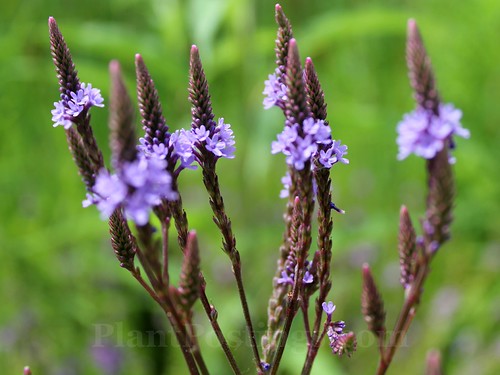
| Blue Vervain (Verbena hastata) |
Do you have a favorite wildflower? I can't say I do, although wildflowers with blooms like this make my heart beat faster.
There's simply something bewitching about Blue Vervain (Verbena hastata). I find the entire effect of it enchanting--the form, the height, the delicate spiking flowers that look like a candelabra. And the color--especially the color.
Would you call that French blue? Greek blue? Maybe more like periwinkle?

For years, I've been fascinated with this tall (up to six feet) plant. Shown here with Dogbane (Apocynum cannabinum), it often towers over the plants around it. While that's part of its appeal for me, I don't think I have the best habitat for it in my own garden. Also, it prefers moist soil and full sun. But whenever I see it in the wild, I swoon.

The pollinators love it, too.
Recently, when I was researching Blue Vervain, one source listed it as an annual. But more recently most sources I'm finding say it's a short-lived perennial that re-seeds itself. It would probably be happy in a wet meadow or a rain garden.
 |
| Hoary Vervain (Verbena stricta)--showing its own foliage and Purple Love Grass (Eragrostis spectabilis) in the background. |
Blue Vervain is closely related to Hoary Vervain (Verbena stricta), also a beautiful plant. Hoary Vervain's foliage is wider and more ovate, compared with Blue Vervain's more lanceolate foliage. And its flowers tend more toward the lavendar/pink hues. One pleasant characteristic of Hoary Vervain is that it doesn't grow quite so tall--only to a maximum height of about four feet. Plus, it's drought-tolerant.
But, back to Blue Vervain ... a few other plant characteristics listed by the Lady Bird Johnson Wildflower Center, include:
- Native to most of North America, predominantly in moist prairies and damp thickets;
- Blooms June through September;
- Attracts bees, birds, and butterflies;
- Larval host to the Common Buckeye butterfly; and
- Prefers sun, but will grow well in partial shade (or even some shady locations).

Definitely a wildflower worthy of high praise on this August Wildflower Wednesday! Thanks to Gail at Clay and Limestone for hosting this wonderful meme. Head on over to her blog to learn more about wildflowers blooming around the world.
Next up: the Garden Lessons Learned meme! What have you learned in your garden during the past few months?
