
What a difference a week makes!
In my last post, we still hadn't had a killing frost. Then this past Friday, Nov. 20, we had a snowstorm that brought us about five inches of fresh white stuff.
 The Marigolds
are history now. It's weird to have a late frost and an early snow in the same season. But it is what it is.
So ... no more outdoor blooming plants around here until spring. There will be several months ahead to talk about winter, so I'm stepping back in time. My plant of the month for November is one that blooms in mid- to late summer.

The Cup Plant (
Silphium perfoliatum) has a pretty, yellow Daisy-like flower. It's not a huge flower (about 3" in diameter).

But the plant itself is very large and tall (4 ft. to 10 ft.), towering over other plants in its native prairie habitat: from Ontario south to Georgia and west to the Dakotas and Oklahoma. Cup Plant is hardy in USDA zones 3 to 9.

In fact, like the other Silphiums, including Prairie Dock (
S. terebinthinaceum) and Compass Plant (
S. laciniatum), Cup Plant even towers over the tall prairie grasses. Wholeleaf Rosinweed (
S. integrifolium) is a bit shorter, at 2 ft. to 6 ft.
I've never tried this, but I'm thinking Cup Plant would work well along a tall wall, at the back of a garden bed. Cup Plant thrives in normal to wet garden soils, and will tolerate clay soil, according to the
Lady Bird Johnson Wildflower Center. Once established, however, it has a high tolerance for drought, due to its long tap root, which can extend 12 ft. to 14 ft deep.
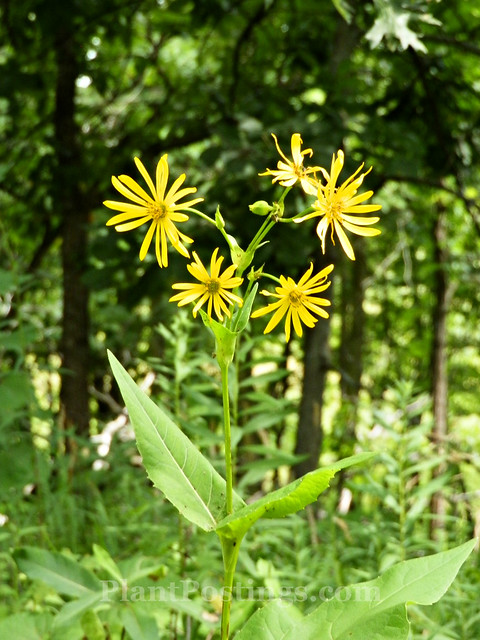
Being a prairie plant, it prefers full sun. But I've also often seen it growing at the edges of woodlands, in partial sun. This is one of the fishman's favorite plants. We frequently see Cup Plants along our hiking trails.

The fishman gets a kick out of the structure of the leaves, where they come together at the stem.
They form cups that collect rain water, which attracts birds and pollinators.

Cup Plant provides special value to native bees and honey bees, and provides nesting materials/structure for native bees, according to the
Xerces Society for Invertebrate Conservation.

It has an "unstoppable urge to reproduce," describes The Lady Bird Johnson Wildflower Center. "They will pop up everywhere; very little care needed."
I know butterflies are attracted to Cup Plant--during one hike this past summer, we noticed Tiger Swallowtails all over it.


Bye-bye!
I'm linking this post to Gail's
Wildflower Wednesday meme at Clay and Limestone and Diana's
Dozens for Diana at Elephant's Eye on False Bay. Head on over to their blogs to learn more about wildflowers and unique plants from around the world.
Next up: the quarterly
Garden Lessons Learned meme! What have you learned in your garden during the past few months? Donna at Gardens Eye View also hosts her companion
Seasonal Celebrations meme. I hope you'll join us. You can share posts for both memes, or one post that covers both lessons
and celebrations.
Happy Thanksgiving! Season's Greetings!


