Showing posts with label solutions. Show all posts

July 30, 2016

Disappointments, Surprises, and a Little Patience

bumble
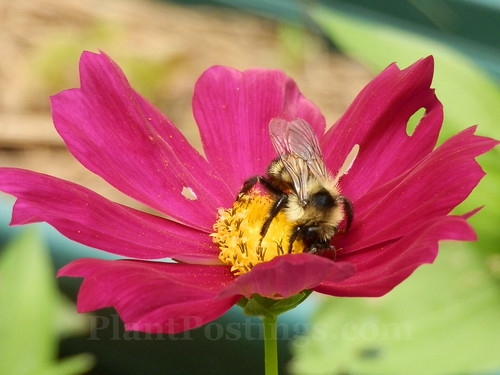
This "vision" worked: a happy bumble bee on a 'Sensation Mix' Cosmos (C. bipinnatus).

Have you ever had a plan or a "vision" for your garden that didn't work out?

That's what happened to me last year. I realized I didn't have enough fall-blooming, native perennials in the shady section of the garden, so I planted some.

In my mind, the Blue Mistflowers (Conoclinium coelestinum) would form a magical, soft swathe around the Swamp Milkweed (Asclepias incarnata). The Zigzag Goldenrod (Solidago flexicaulis) would arch gracefully along the trellis, and the False Asters (Boltonia asteroides) would bob and sway surrounding the Anise Hyssop (Agastache foeniculum) and the 'Vibrant Dome' Asters.

Unfortunately, the rabbits had a different vision. They ate all these plants down to the ground, except for the Milkweed (no taste for it), a few of the Asters, and the Mistflowers (which I rescued in time).

After decades of gardening--much of it in this current unbalanced ecosystem--I should have known. But most of these plants (except for the Asters) are generally considered "rabbit-resistant." Well, apparently these rabbits didn't get the message. I'd say a different animal was to blame, but the clues were obvious (and too numerous to list here). Not to mention trying to chase the long-eared pests out of this part of the garden several times.

So, I had to get creative. While the Agastaches and the Boltonias didn't return this year (whether victims of rabbit death or the freeze/thaw curse, I'll never know), the others did. And I discovered some happy surprises.
misflower

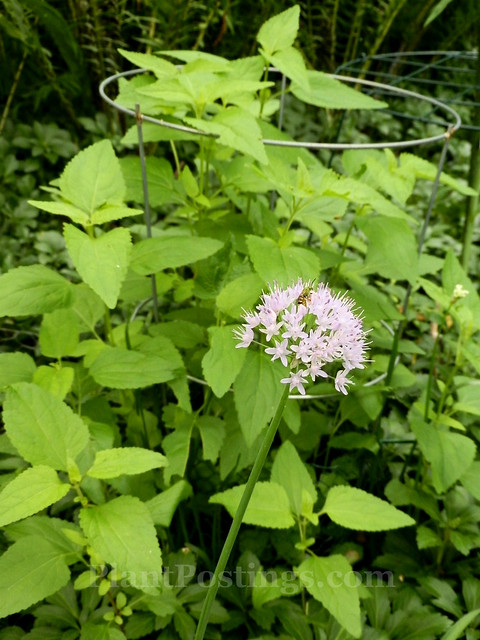
I surrounded the Blue Mistflowers in lava rocks and chicken wire-covered tomato caging, and planted 'Summer Beauty' Alliums around the perimeter. These things seem to be working and soon you won't even see the caging. Fingers crossed.
jewelweed

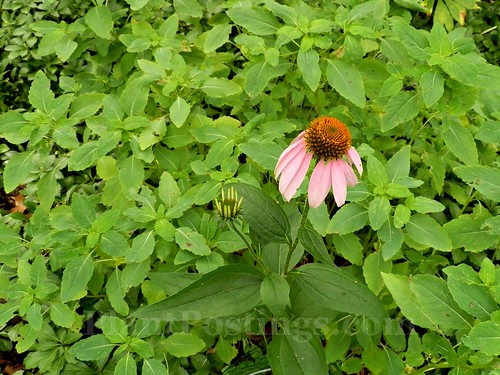
Oh, I forgot to mention I scattered seeds of Spotted Jewelweed (Impatiens capensis) in various spots around the garden. They really took off! In the spot where the Agastache and the Boltonia were located last year, is now a mound of Jewelweed surrounding a new planting of Purple Coneflower (Echinacea purpurea). I'm thinking this will soon be a popular spot with the hummingbirds. There are Alliums in here somewhere, too.
obelisk

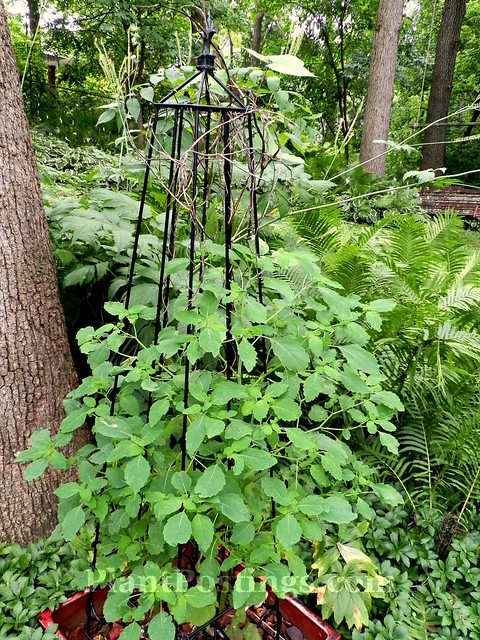
Yes, this is also Jewelweed. It's cuddling the obelisk, at the center of which is a Purple Hyacinth Bean vine, which is about to bloom. I forgot I sprinkled Jewelweed seeds here, too. Surprise!
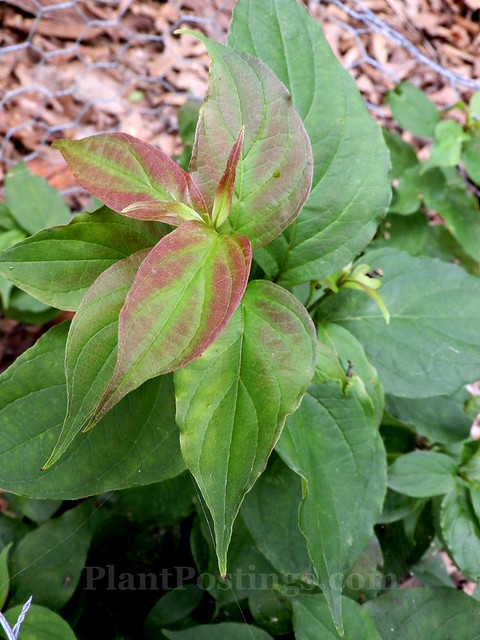
cornus pumila

Other victims of the big-eared, large-fanged, plant-killing monsters were the four Dwarf Red-Tipped Dogwood (Cornus pumila) shrubs. Yep, the rabbits chewed them down to the ground during the winter. So, I rolled out more chicken wire, which will remain around the shrubs until they become established. Thankfully, they recovered from the insult.

OK, so most of those areas are under control ... for now. Here's another surprise:
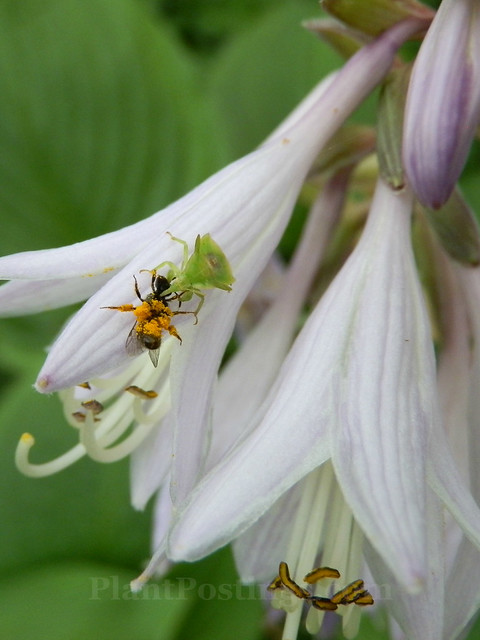
bugs 1

I walked by one of the Hosta flowers the other day and saw this. From a distance it looked like a bit of leaf with a strange pollen-covered bug next to it. On closer examination, I realized the pollen-covered bug was a bumble bee (I think). And with help from a few garden blogger friends (you know who you are...thanks!), I found out the green insect is an Ambush Bug Nymph. A sad, cruel, and yet fascinating natural occurrence.

Quickly shifting the topic...

Finally, I'm once again reminded about the rewards of patience. The Zinnias I planted from seed in late winter/early spring are now big and robust and ready for cutting. They'll offer repeat blooms now until October. Yay!
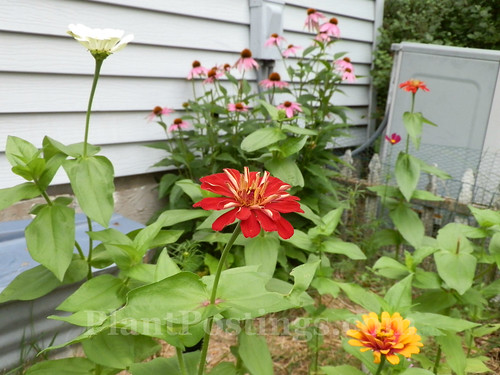
seeded

It's difficult to show a good angle on the cutting garden because it's on a steep hill on the side of the house. But you get the idea here: My only sunny garden is a small patch of land that, when blooming, camouflages (sort of) the window wells, the utility boxes, and the air conditioning unit.

When the Zinnias, Coneflowers, and other sun-lovers are blooming, it's a bright and cheery place full of pollinators.
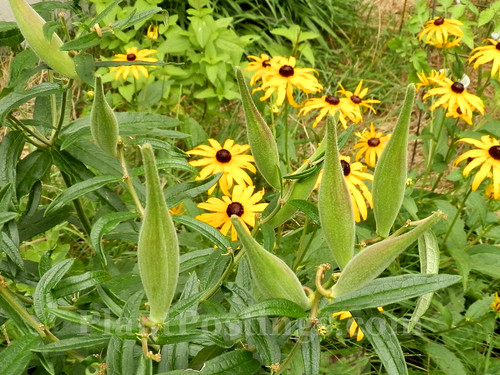
seed pods

The Butterfly Weed is forming seed pods.
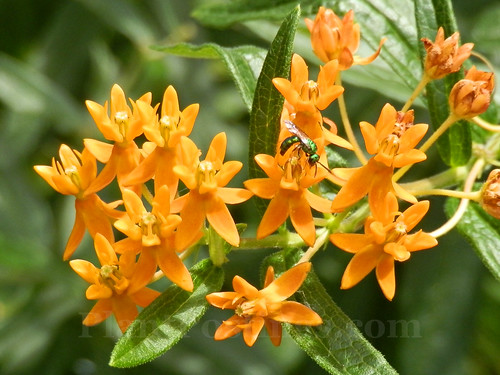
sweat bee

And enough blooms remain to keep the sweat bees full and sassy. Here's a little movie I made to celebrate:


Overall, the disappointments, surprises, and joys have a way of balancing out. And patience (with a few tricks) certainly pays off.

(Oh, and I must say I've tried just about every potion and scare tactic for the rabbits. Each one works temporarily, but in the end the only things that work long-term for me, here in this "rabbit wonderland," are rabbit-repellent plants--not rabbit-resistant ones--and miles of chicken wire.)

September 21, 2013

Lessons and solutions

hyacinth

'Whatever the problem, be part of the solution.'

~Tina Fey, "Bossypants," 2011


There are many variations on this sage advice, but I like Tina Fey's take on it.

Problems certainly are overwhelming in today's world--including the natural world. But after many years of comparing wisdom and advice with gardeners and garden bloggers, I'm convinced we're part of the solution.

milkweed

If you need convincing, take a look at this TED talk that has been circulating about "Why Bees Are Disappearing." If you haven't seen it yet, and without getting into too much detail, the main point is that bees need more flowers--particularly native flowering plants--for pollination, and agriculture needs healthy bees. Obviously, gardeners, in general, are part of this particular solution. Yes, of course, we can help!

As individual gardeners, we can't save the world ... or the butterflies ... or the bees. But as a large group of people working together on the solutions, we can make a difference.

That's the biggest lesson I learned this summer. There's hope and joy in knowing that gardeners around the world are making similar efforts to tend their gardens and, in the process, improving habitats for their gardens' visitors--of all species.

turkeys

With that, I thank you for doing your part, and for sharing your unique lessons from the past season. Wrapping up the "Lessons Learned" meme:

Lyn at The Amateur Weeder, in New South Wales, Australia, admitted that even though she's a stickler for identifying plants by their Latin names, she misidentified Veronica hederaefolia as Stellaria media (isn't that a common mistake?). She also discovered that yellow is her favorite garden color during her mild winters, and that she doesn't want an interesting winter garden--she wants it to rest!

Karin at Southern Meadows, in Georgia, U.S., faced unusual growing conditions this season. Summers are typically hot, humid, and dry in her part of the world, and for the past three years, they've had extreme drought. But this summer, it rained ... a lot! All the drought-tolerant plants she'd planted didn't like the rain. Her lesson: Get to know the native "weeds" in your garden--they're the plants most likely to survive the extremes.

Holley at Roses and Other Gardening Joys, in Texas, U.S., finally realized it's sometimes necessary to remove plants to make her garden the best it can be. "I don't want a garden that's just alive," she explained. "I want something more.... I want the garden of my dreams."

Helene at Graphicality-UK, in London, U.K., found a great spot for Sunflowers in her garden, but some of the seedlings struggled. She planted seeds directly in the soil between her Roses and shrubs. A few Sunflowers put on a great show, but others were shaded by the other dominating plants. Next year, she'll plant the Sunflower seeds in pots first, so they can get a good start before placing them in the garden.

Diana at Elephant's Eye, in Western Cape, South Africa, recounted the lessons she has learned in her beloved garden since moving to the property in 2007. She'll move to a new place soon, but the garden lessons will all be pleasant memories and a key part of her knowledge base. The challenges of gardening in her Mediterranean climate--long, hot summers and wet winters--mean she now knows a lot about rain gardening.

viburnum

Tammy at Casa Mariposa, in Virginia, U.S., shared a humorous take on the importance of listening to Mother Nature. In a laugh-out-loud post, she admitted that she failed to follow Mother Nature's guidance, which resulted in some not-so-surprising garden challenges. But she also shared some of her stunning successes.

Rose at Prairie Rose's Garden, in Illinois, U.S., shared lessons from her vegetable garden. "Just when I'm feeling rather smug that I've acquired enough knowledge to call myself a true gardener," she said, "I learn some new things that make me realize how little I really know." Rose included five excellent lessons for anyone who wants to grow vegetables--or any other plants. One key lesson: Nature can be cruel.

Susie at Life.Change.Compost., in Oregon, U.S., tied life decisions to garden lessons. We all know they parallel each other, but Susie drew a poignant comparison between planting seeds and deciding whether or not to have children. "No guarantees, this business of planting seeds," she said. "If I am going to look a heartache in the face, a garden is a good place to do it."

Angie at Angie's Garden Diaries, in Scotland, U.K., experimented with gathering seeds from plants in her garden, with mixed results. She collected seeds from Meconopsis, Primula, and Tropaeolum. She described how some of her techniques worked well, and others didn't--but she was pleased to call herself a "real gardener" and will collect and sow more seeds in the future.

Donna at Gardens Eye View, in New York state, U.S., learned that she needs to make time to simply "be" in her garden--for her physical and her mental health. "I think it's best to take our cue from the garden and nature," she said. "Feel its rhythm and connect to it. Savor the opportunities as they happen."

Sue at Diary of a Suburban Gardener, in Melbourne, Victoria, Australia, learned why it's helpful and important to incorporate indigenous plants in a garden. One benefit is that they attract wildlife and serve as the perfect habitat for critters to live out their life cycles. Sue also learned how to create more "lizard lounges" in her garden.

lilypad

Others who participated through their comments included Jen at Muddy Boot Dreams, who wished she'd planted more Zinnias. Donna at Garden Walk, Garden Talk reminded us that nature is still teaching us lessons, and she hopes it isn't too late for us to learn them. Lynne at Irish Garden House, learned to water less, let nature care, and reduce the number of bird feeders.

Sarah at Galloping Horse Garden learned that it's nicer, but more distracting, to have an office looking out onto the garden. The Phytophactor shared that sometimes Swamp Milkweed volunteers where least expected. Aaron at Garden of Aaron had a powdery mildew issue on his Zinnias, and will plant a different variety next year. Corner Gardener Sue planted her Zinnias late, but she did get some blooms in September.

moss

That's quite an impressive collection of garden lessons this season. If you've written a post during the past few months that fits here, feel free to add the link in your comments. And, of course, if I've forgotten anyone, please let me know and I'll update the post.

Thanks to all--for sharing the lessons and for caring about the solutions.

swing