Showing posts with label chipmunks. Show all posts

September 15, 2015

Late-Season Vignettes and Fab Foliage

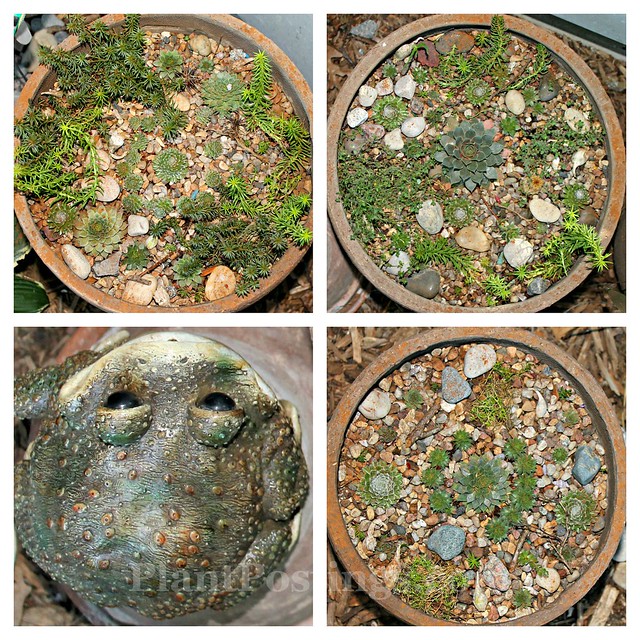
succulent collage
Scallions, hot pepper flakes, cinnamon, thorny sticks, and a croaking toad are all attempts to
repel chipmunks from these succulent pots.

As the growing season winds down and the plants are starting to fade, there are still several vignettes that I'm finding relatively pleasing to the eye. The succulent pots are filling in nicely, although I'm occasionally finding Sempervivums and Sedums upended by chipmunks.
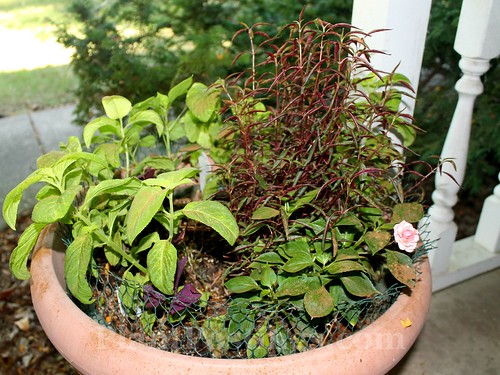
porch pots
Yes, more cinnamon to repel the chipmunks!

I'm also pleased with the chartreuse, magenta, pink, and green of Coleus, Impatiens, Oxalis, and Alternanthera (although I think they looked better in July).
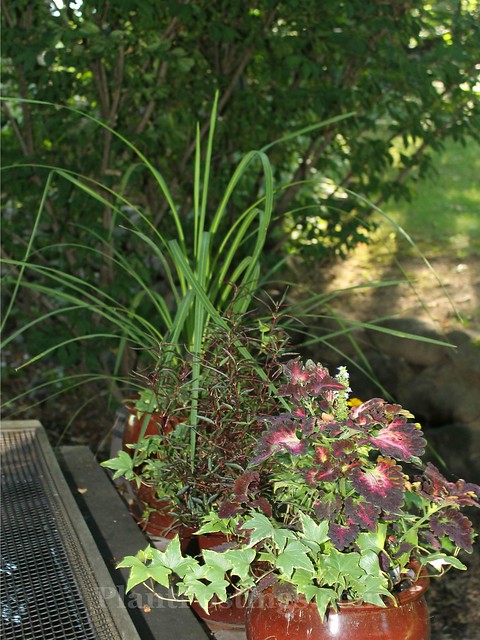
pond pots

The pots by the pond have improved as the season has progressed--filled with variegated Coleus, Hedera, Alternanthera, a Cordyline and a few Marigolds (Tagetes spp.) blooming in the dappled sun.
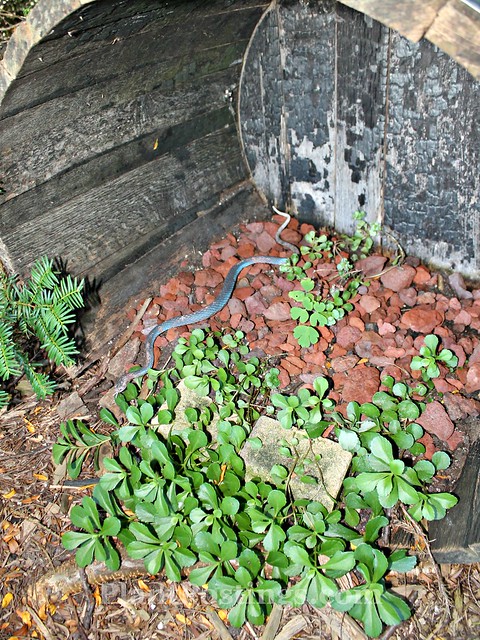
whiskey barrel
Lava rocks to discourage digging, and a fake snake to scare away critters.

I've finally figured out what works in the north-facing whiskey barrels--various Sedums that spill out the front and Wild Columbine (Aquilegia canadenis), which blooms in the spring, goes dormant, and makes a repeat appearance in late summer/early fall.
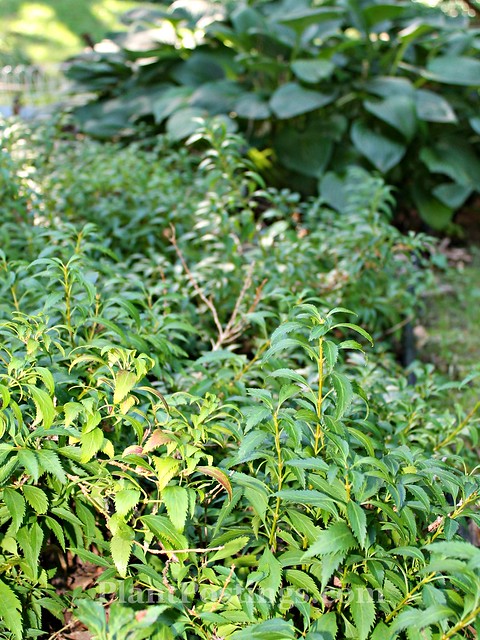
dwarf forsythia

Sometimes I curse this dwarf Forsythia (spp. unknown), because it's impossible to rake around it. But it's growing on me. The spring flowers are unimpressive, but the low-growing shrub/hedge makes a nice ground cover in the summer, and the foliage turns to variegated fiery hues (starting to show here) in the fall. This time of year, it complements the blue/green of its neighbor large-leafed Hosta.
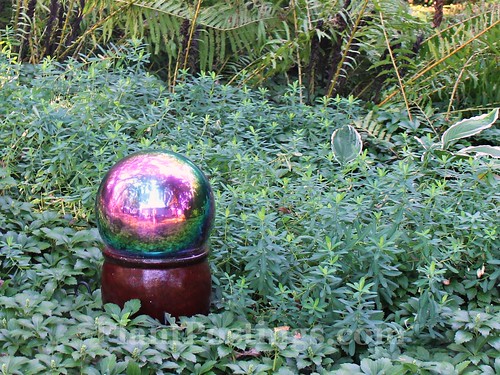
cushion spurge

Finally, the Euphorbia polychroma has performed well this growing season, forming a pleasant ground cover. While the surrounding ferns are fading and the Hostas are nibbled away by the rabbits, the blue/green of the Euphorbia still looks relatively decent.

I'm linking this post to Pam's Foliage Follow-Up at Digging, and Anna's Wednesday Vignettes at Flutter & Hum. Visit these excellent blogs for more garden inspiration.

* * * * * * * * * * * * * * * * * *

There's still time to participate in the "Garden Lessons Learned" meme. Feel free to write a post or share one you've already written about your "Lessons Learned" during the past season. Then share your links or simple observations in the comments at: Garden Lessons Learned, Quarter 3, 2015. The link will be available always under the "Lessons Learned" tab at the top of this blog.

Please also join in Donna's Seasonal Celebrations at Gardens Eye View! You can join in with a post that fits both memes, or separate posts for one or both of them. I'll include wrap-ups on PlantPostings' Facebook page, starting within the next few days and leading up to the equinox.

July 21, 2013

A strange and challenging microclimate

I enjoy experimenting with microclimates, but it can get expensive. Years ago, when our family purchased this property, most of it was tastefully and naturally landscaped. It didn't take a lot of effort to settle into this house and garden--actually, the garden is what sold me on this place.

But, thankfully, there were a few garden "rooms" that required a little attention--giving me a chance to add my own touch. One of them is difficult to describe ... but I'll try:

It's an internal corner plot, under an eave, facing south and west. It's shaded from the sun entirely in the morning, it gets dappled shade/sun during the midday, and then the hot afternoon sun bakes it from about 2 p.m. to sunset. Being under the eave, it gets very little rainfall--mostly from the wind blowing precipitation into the little corner. The front of the plot is bordered by low-growing Forsythia shrubs, whose future is questionable (that's another post).

My first attempts at planting in this corner were completely unsuccessful. I can't even remember all the plants I tried. Then I tried some Daylilies, and they did quite well--at least the ones that weren't entirely under the eave.

About two months ago, I decided to experiment a little more. Anything planted directly in the ground was destined to fail, for lack of precipitation and sun--because the area would be shaded by the Lilies and the Forsythias.

Finally, I had a light-bulb moment! How about trying succulents in pots? I told the fishman about my plan, and he found me three matching clay pots of varying heights. All three had small holes in the bottom, and I added rocks; then filled the pots with a mixture of soil, sand, and perlite, to ensure adequate drainage.

I purchased several plants, and I was incredibly excited to have my very first succulent garden! (I've grown various Sedums over the years--but never a garden devoted entirely to mixed succulents.)

Of course, as with most first attempts, this garden was not entirely successful. Most of the plants survived, but two are now mere memories: Armeria maritima and Sempervivum 'Skirockii.' Of course, I don't know for sure, but I think the Armeria might have died for lack of consistent sunshine. And here's the problem with the Sempervivum:

damage
See the holes in the leaves?

damage2
Who was digging in this pot?

Yes, you are correct: chipmunks! They were digging in the pots and chewing on the plants! For such cute little critters, they can inflict a lot of plant damage! I tried hot Pepper repellent and Garlic--both of which seemed to attract the nasty little cuties even more.

toad
Time to scare away those pesky chipmunks!

This motion-activated croaking toad was a cute addition to the garden. But he can't get wet and must be removed from the garden during a heavy downpour (we've had a few of those this summer).

The only thing that seemed to keep the chippers away longer than a few hours was crushed Marigold flowers and seeds--sprinkled among the plants. But that was only a temporary fix.

Then I thought, how about adding some Cacti? Wouldn't the prickly spines discourage digging? I knew some Cacti are native here, and I watched a video program about how other species are cold-hardy and can survive our winters. Perfect for outdoor potted plants!

So, I ordered two Hedgehog Cacti, Brittle Prickly Pears, and (believe it or not!) an Agave, from Cold Hardy Cactus:

echinocereus
Echinocereus caespitosus

escobaria
Escobaria missouriensis

opuntia
Opuntia fragilis 'Black Cat'

agave
Agave utahensis v. Kaibabensis

They've joined the other plants that seem to be thriving now, despite a little damage from Alvin, Theodore, and Simon Chipmunk.

xenox
Sedum 'Xenox'

spurium
Sedum spurium 'Fire Glow'

sempervivum
Sempervivum 'Red Beauty'

kamtschaticum
Sedum 'Kamtschaticum'

angelina
Sedum rupestre 'Angelina'

I'll keep you posted; fingers crossed. Perhaps I've found a good solution to this strange and challenging microclimate? I might even try to plant the seeds from the now defunct S. 'Skirockii.'

skirockii
Sempervivum 'Skirockii' -- sadly blooming before its demise.

Maybe it will live, through its "offspring," to see another day.