Showing posts with label fungi. Show all posts

October 10, 2026

Scouting for Fabulous Fungi

collage

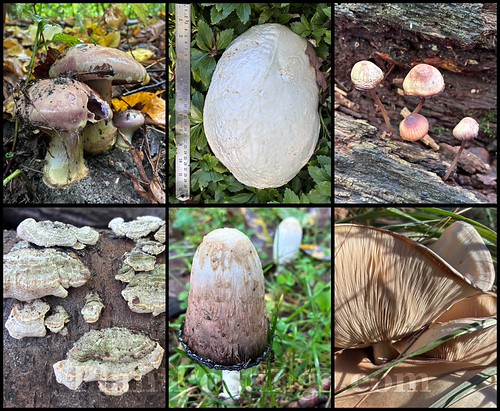
It's that wonderful time of year when cooler air temperatures and autumn precipitation encourage the growth of fungi. Here are several examples I've noticed recently during hikes and at home. I'm including this post for "Six on Saturday," hosted by Jim at Garden Ruminations.

I'm not a mycologist or a fungi expert, so please correct me if my ID here is errant:

giant puffball
Giant puffball
Calvatia gigantea

atkinsons fungi
Atkinson’s fungus
Cortinarius atkinsonianus

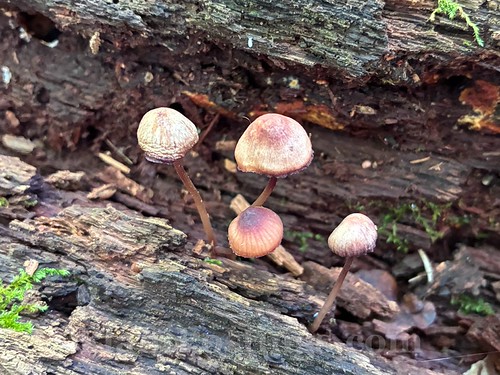
bonnet fungus
Bonnet fungus
Mycena inclinata?

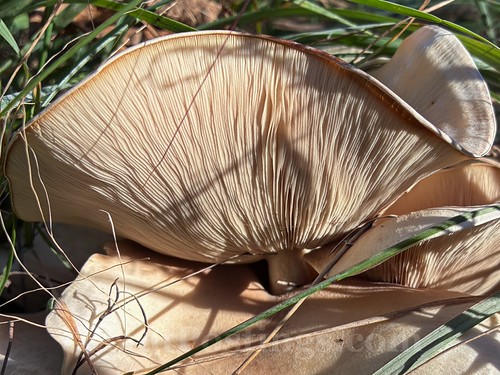
giant funnel
Giant funnel
Aspropaxillus giganteus

shaggy ink cap
Shaggy ink cap
Coprinus comatus

false turkey tail 2
False turkey tail
Stereum fasciatum

Here's a great resource describing the benefits of fungi--in our gardens and beyond: Ten reasons why fungi are crucial to the planet.

For more fabulous "Six on Saturday" entries, visit Garden Ruminations.

February 10, 2016

Life Under the Arctic Blast

100_4528

Rabbits, rabbits, everwhere! Did you notice (above) the rabbit-sized impression at the base of the sled?

100_4527

I'm thinking a rabbit was resting here on a warmer day when the snow was slushy.

100_4518

Evidence is everywhere in the garden--rabbit tracks, scat, chewed branches, and telltale angular bite marks on the shrubs.

100_4496

I had to cage the Dwarf Dogwoods (Cornus pumila), because rabbits were chewing them down to the ground.

But, enough about rabbits. Rabbits will always live here.

In other news, it's bitter cold this week in the Midwest, with highs and lows hovering near 0F/-18C. But before the Arctic blast, I wandered around the garden on a mild day, taking stock.

100_4455

Fortunately, the Hellebores, Epimediums, Roses, and other plants in the stone wall garden are covered in a toasty blanket of snow. They'll be fine. They've survived much worse.

100_4509

The toad sundial greets me as if to say, "Really? You left me out here all winter?"

100_4507

Spotted Deadnettles (Lamium maculatum) are confused--alternately greening and browning with the waves of warm and cold weather. They'll bounce right back in a few days. They may even flower later this month if we get a dramatic thaw.

100_4502

Among my favorite discoveries in the winter garden: areas where moss meets ice meets rock meets lichen. Interesting that rodents seem to choose these spots to store their winter food.

100_4489

Apologies for this is a horribly bright photo of Cranberrybush Viburnum (V. trilobum) berries. The flash went off, and it's too cold today to venture out for a better image. Anyway, a few berries remain, although birds have eaten most of them by now.

100_4484

The fishman roped up the Christmas tree in the woods, to serve as wildlife cover. I haven't noticed much activity here, but a few animal prints weave around the area. The tree looks pretty, and I'm sure birds fly in and out of it for cover, even if I can't see them from the house or through the binoculars.

100_4467

However, I can see this chewed log from my kitchen window. On closer inspection, I'm wondering what animals have been gnawing here? Squirrels, raccoons? The elevation above the ground is a little too high for rabbits. Chipmunks are hibernating.

100_4472

In some of the areas where the log is chewed and decaying, fungi are forming. They're so beautiful.

100_4477

I noticed this one latched on the end of a small branch.

100_4461

OK, so it's cold this week. So what? Miniature Daffodils (Narcissus 'Tete-a-Tete') are waiting patiently for warmer weather. It's only a matter of time.

What's happening in your garden this week?

January 28, 2016

Epiphytes, Wildflowers, and Gators!
(At Myakka River State Park)

P3064126

This place is a "must see" for visitors to Florida's gulf coast. Myakka River State Park is located about nine miles east of Sarasota. One of the state's largest and oldest parks, it offers excellent hiking trails through various park ecosystems--including wetlands, rare dry prairies, hammocks, and pinelands.

My family visited the park last year in early March. It was a highlight of our time together, and it's funny: We didn't know anything about this place until we researched things to do the day before our visit.

P3064104

The first amazing thing I noticed was the Blue-Eyed Grass (Sisyrinchium antustifolium) surrounding the parking lot. I posted about this plant in May.

P3064107

The hiking trails we used were extremely well-maintained and easy to traverse. We covered only a small area, but the park includes about 39 miles of loop trails through shady Live Oak/Palm hammocks, sandy Pine flatwoods, sunny dry prairies, and marshes--all teaming with fascinating plants and wildlife.

P3064108

Soon after we entered the park, we headed for the canopy walk.

P3064165

Along the way, we walked through a "jungle" of Oaks and Palms.

P3064163

Just as I found myself wondering what species of Palm I was seeing ...

P3064182

A sign described the differences between Sabal Palms (Sabal palmetto) and Saw Palmettos (Serenoa repens), both native to Florida.

P3064110

P3064137

P3064119

I think most of these young plants I captured in photos are Sabal Palms.

P3064145

This tree had a fascinating growth pattern. I wonder how this happened?

Soon, we reached the canopy walkway, suspended 25 feet above the ground and extending 100 feet through the hammock canopy.

P3064123

So awesome!

But before you move to the next photo, I must share a personal story: I'm afraid of heights. I find it extremely difficult to climb open-air towers. Guess what? Part of the canopy walk includes climbing an open-air tower!

I don't have any photos of the climb, because I was hyperventilating and shaking most of the way up. (Here's a great video of what you can expect.)

My family encouraged me all the way ... to the pay-off ...

P3064128

Jungle wilderness as far as the eye could see, in every direction! I'm so glad I didn't miss out on this!

Completed in 2000, the canopy/tower walkway was the first public treetop trail in North America. The tower extends to 74 feet above the forest floor.

No photos of the climb back down, but that was much easier (for me). Still so much more to see ...

P3064141

This moss really was this bright green!

P3064121

Mosses, ferns, lichens, and fungi were everywhere. I found the epiphytes particularly fascinating.

P3064164

P3064166

P3064153

P3064156

Just imagine how many life forms were living on this tree trunk!

P3064167

Did you see the lizard?

P3064162

Of course I had to snap a photo of this colorful mushroom. Based on quick research, I'm guessing it was a poisonous Russula emetica?

P3064155

There were several benches along the trails for resting and reflecting.

P3064179

And numerous wildflowers, including this Iris, which I believe is a Savanna Iris (I. hexagona var. savannarum).

P3064161

And this St. John's-wort, which I think is St. Andrew's-Cross (Hypericum hypericoides).

P3064169

Boardwalks stretched through the wetland portions of the trail.

P3064146

Easy walking with more benches along the way ...

P3064149

Warnings along the trail alerted us that alligators were present, but looking at this scene I never would have guessed danger lurked below the water's surface.

P3064194

Judging from the behavior of water fowl, I never would have guessed it either.

In fact, we saw no gators until we began driving out of the park. We noticed numerous parked cars near a bridge over the river, so we stopped to check it out.

P3064205

Perfectly pastoral, safe, and innocent, right?

P3064205a

But, did you see this? Fortunately, I had my optical zoom camera with me ...

P3064206

Oh yeah.

P3064192

Turns out, I didn't need the telephoto: The gators were all around us in the water and under the bridge!

P3064202

They sure blended in to the water's color and its rippled surface.

P3064200

P3064189

I don't recall seeing gators in the wild before: Just one of many reasons our trip to Myakka River State Park was incredible. And I want to go back!