 |
| Upper Range Light, which along with the Lower Range Light, was built in 1869. |
 |
| Lower Range Light, nearly 1,000 feet directly to the south of the Upper Range Light. From the water, a sailor got "on range" by lining up, vertically, the lights in the two buildings. |
If you live near Door County, Wisconsin, or you ever plan to visit, make sure The Ridges Sanctuary is on your "must see" list. It's one of the most unique collections of habitats and plants found in the U.S.
The Ridges began as a labor of love by private citizens to preserve a unique tract of land on Bailey's Harbor. The sanctuary, formed in 1937, was Wisconsin's first land trust. The most biologically diverse ecosystem in Wisconsin, it's home to more than 475 plant species, including 25 of the 40 species of Orchids native to the state, and 60 species of migrating and nesting birds.
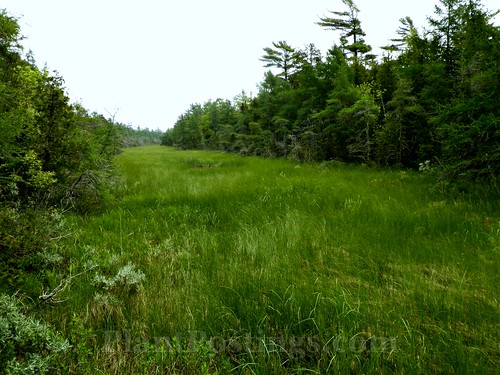
The sanctuary is named for its distinctive topography: a series of 30 ridges and swales formed by the movement of Lake Michigan during the past 1,400 years.


This ridge-swail complex provides a wide range of environmental conditions--from open beach, to bog, to densely shaded conifer forest. Click here for a Google Earth image of the area, where you can see the unique ridge formations.
When we visited earlier this summer, Yellow Lady Slippers (Cypripedium parviflorum) and Indian Paintbrush (Castilleja coccinea) were in full bloom.


I've never seen so many Yellow Lady Slippers in one place before--growing here and there, in large groupings, and even alongside the roadway.


The Indian Paintbrushes were beautiful up close, and when viewed in a meadow--thick with their bright, flaming highlights.
Other plants of note:

Cranberry Viburnum (Viburnum opulus var. trilobum), which was blooming in many places around the peninsula.

Starflower (Trientalis borealis)


Pitcher Plant (Sarracenia purpurea)

Marsh Marigold (Caltha palustris), which had recently finished blooming

Labrador Tea (Ledum groenlandicum)

Vast stretches of Irises growing with Junipers, which must be lovely when blooming

Gaywings (Polygala paucifolia)

Numerous sedges--I think this is Brown Bog Sedge (Carex buxbaumii)


And fabulous mosses of various shapes and sizes.
There's so much more to The Ridges than I can cover in one post, but this offers a small hint of its uniqueness. I'd like to go back during a different phase of the growing season to see other plants in their prime.
**********
Update: Please note the link in the second paragraph above to a partial list of plant species at The Ridges. And special thanks to The Phytophactor for helping to identify the sanctuary's unique mosses.

